Data
Three datasets are published in their own right, each with its own version line. You do not need to run anything, and you do not need Julia.
| Dataset | Version | Where | |
|---|---|---|---|
| F(s, E₀) | Inner-shell ionization form factors for STEM-EDX, 525 channels | dataset 7.0.0 | Zenodo 10.5281/zenodo.22643468 · GitHub release dataset-v7.0.0 |
| f_x(s), f_e(s) | X-ray and electron atomic scattering factors, 86 neutral atoms | dataset-factors 2.0.0 | Zenodo 10.5281/zenodo.22820415 · GitHub release dataset-factors-v2.0.0 — see below |
| f_x(s), f_e(s), anions | The same two factors for 22 Watson-sphere-stabilised anions | dataset-factors-ion 1.0.0 | Zenodo 10.5281/zenodo.22820492 · GitHub release dataset-factors-ion-v1.0.0 — see below |
F and the scattering factors are different families of numbers. \(F(s, E_0)\) describes how an inner-shell ionization is distributed in momentum transfer, for one element, one subshell and one beam energy; it is what a STEM-EDX or ALCHEMI simulation needs. \(f_x(s)\) and \(f_e(s)\) are the ordinary elastic atomic scattering factors of X-ray and electron crystallography — the numbers that Waasmaier & Kirfel (1995) or Peng et al. (1996) parameterize — computed here from the same atom instead of read from a fit.
Inner-shell ionization form factors F(s, E₀) — dataset v7.0.0
Read this page before using the numbers
F is signed, the momentum convention is q = 4πs, values past s_cert are
padding rather than physics, and the E₀ axis differs from channel to
channel. Each of these has been observed to break a consumer. They are set
out under The contract below, and checked by an executable
reference loader shipped inside the archive.
Nuclear-model erratum: dataset F v4.0.0–v6.0.0
The provenance description "finite nucleus (uniform sphere R = 1.2 A^{1/3} fm)" is incorrect. These releases used a point nucleus throughout the SCF, bound-state, relaxed-ion and continuum calculations. Interpret them as point-nucleus tables. Their original archives, numerical values and checksums remain unchanged.
Dataset F v7.0.0 introduces a finite, uniformly charged sphere
under a distinct model_id ending in -FNUSX, with corrected
provenance. Sphere radii are derived from IAEA-compiled experimental
rms charge radii where available; Tc, Pm and At use the documented
formula fallback.
Against a point-nucleus control computed with identical numerical
settings, the maximum absolute difference in F over each tabulated
row's s grid ranges from 1.5 × 10⁻⁸ to 5.0 × 10⁻⁴ across all 525
channels and 14,796 rows — one row being one channel at one beam
energy. These are observed model differences, not error bounds, and
they vary by shell; changes from older releases also include
numerical-method updates. The control tables are included in the
v7.0.0 archive under control_point_nucleus/, so this comparison can
be recomputed independently.
Where to get it
| Record of reference | Zenodo, 10.5281/zenodo.22643468 — the version DOI |
| Mirror | GitHub release dataset-v7.0.0 |
| Size | 92 MB compressed, 235 MB expanded — of which the point-nucleus control set is 111 MB |
| Licence | data CC-BY-4.0, bundled loader MIT |
The two copies are byte-identical. The archive is built deterministically — sorted entries, mtime pinned to the dataset's own date, fixed ownership, no gzip timestamp — so the copy on Zenodo and the copy on GitHub can be compared rather than merely trusted.
sha256sum -c temari-dataset-v7.0.0.tar.gz.sha256   # the archive
tar -xzf temari-dataset-v7.0.0.tar.gz && cd temari-dataset-v7.0.0
python tools/temari_contract.py .                  # the contents; non-zero on failure
temari_contract.py needs nothing but the Python standard library.
Browsing before downloading: the channel index is committed to the
repository as
tables/channels.csv
— 525 rows, rendered by GitHub as a searchable table. It answers "is my element
and edge in here?" without a 92 MB download.
What is in it
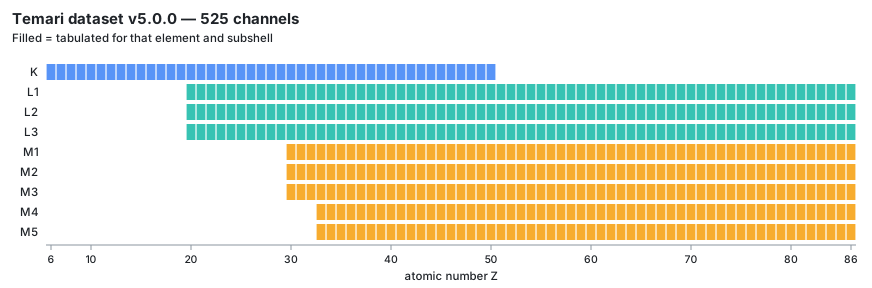
Version 7.0.0, schema 2, generated with Temari on Julia 1.11.9.
| Channels | 525 — K, L1–L3, M1–M5 |
| Rows (channel × E₀) | 14,796 |
| Momentum grid | s = 0 … 16 Å⁻¹, 321 uniform nodes (step 0.05 Å⁻¹) |
| Model | DHFS-KS23-DiracB-KDIRAC2C-jsplit-fullrange-sym-v4-DSCF-FNUSX — the -FNUSX suffix records the finite nucleus |
| Also shipped | control_point_nucleus/ — a point-nucleus control set of the same 525 channels, computed with identical numerical settings, so the size of the nuclear model change can be recomputed. Not for use: it carries dataset_version 0.0.0-dev, its own manifest, and it is not part of the top-level manifest |
Coverage by shell:
| Shell | Z range | Channels |
|---|---|---|
| K | 6 – 50 | 45 |
| L1, L2, L3 | 20 – 86 | 67 each |
| M1, M2, M3 | 30 – 86 | 57 each |
| M4, M5 | 33 – 86 | 54 each |
What a channel is
A channel is one element and one subshell — F_K_Z26.json is iron's K
shell (1s), F_L3_Z79.json is gold's L3 shell (2p₃/₂). Each channel file
holds one row per beam energy \(E_0\); the Fe K file has 28 rows from
30 keV to 400 keV. A row carries F (321 values on the s grid),
s_cert_A_inv, tail.eps, sigma_bote_nm2, sigma_own_nm2, the
overvoltage u = E₀/E_edge, and solver diagnostics. The channel-level keys
give the edge energy used as threshold (e_th_keV_bote, 7.083 keV for
Fe K), the model id, the s grid and the provenance.
What F is
\(F(s, E_0)\) is the shape of the inner-shell ionization form factor, normalized so that \(F(0) = 1\). It is the quantity STEM-EDX and ALCHEMI need: the mixed dynamic form factor contracted over the ejected electron's energy and direction, for two Bloch waves separated by \(K = 4\pi s\,a_0\), then normalized at \(K = 0\) — the off-diagonal response that an EDX map's dependence on crystal orientation is modelled with. ALCHEMI (Atom Location by CHannelling-Enhanced MIcroanalysis) estimates site occupancy from exactly that orientation dependence of the characteristic X-ray yields; Temari supplies the off-diagonal ionization shape factors used by the downstream Bloch-wave simulation, and does not perform the occupancy refinement itself. The physics gives the integral it comes from.
- s is \(\sin\theta/\lambda\) in Å⁻¹, the crystallographic convention. The momentum transfer is q = 4πs, so K = 4πs·a₀ in atomic units. For example, s = 0.5 Å⁻¹ is q = 6.28 Å⁻¹, or K = 3.32 a₀⁻¹.
- F is not a GOS and must not be substituted for one: a generalized oscillator strength keeps the energy loss as a variable and is positive; F has the loss integrated out and is signed.
- F is not a cross section. The absolute scale is supplied separately by
sigma_bote_nm2, from the coefficients of Bote et al. (2009).
The contract
These are not stylistic preferences. Each has been observed to break a
consumer, and each is checked by temari_contract.py.
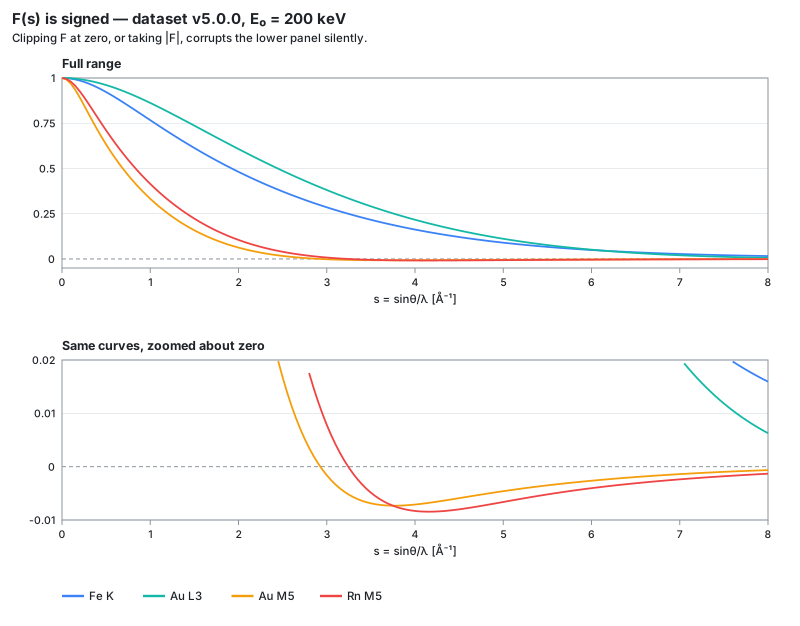
- F is signed. 358 of the 525 channels contain negative values, the
smallest being −0.3194. Any path that treats F as non-negative —
clip(0),abs, an assumption of monotonicity — corrupts it silently, and the corruption survives integration over q. This is why F is not published in the GOSH format, whose consumers clip. - q = 4πs. Using s directly as a momentum is wrong by 4π.
- Beyond
s_certthe values are exactly-zero padding, not calculated. Every row declares how far it reaches. 1,598 rows (10.8 %) stop short of 16 Å⁻¹. Feeding the padding into an interpolation basis drags the result toward zero. - The E₀ axis differs from channel to channel — 459 distinct axes across 525 channels, 22 to 40 rows each. There is no dense [channel, E₀, s] cube over the union axis. (The 22 absolute nodes, 30 keV to 400 keV, are present in every channel; the per-channel overvoltage nodes are what differ.)
epsis an upper bound and must not be interpolated in E₀. Take the maximum of the two bracketing rows — an interpolated bound is not a bound. When E₀ lands exactly on a row, use that row'sepsalone: there is no bracketing pair, and pairing it with a neighbour anyway changes the answer whereverepsis not monotonic in E₀. It is not monotonic in general — for Rn M5 at 30 keV the two readings give 1.29×10⁻⁴ and 1.51×10⁻⁴. The same applies tos_cert: on a node it is that row's value, and between rows take the smaller of the pair.- E₀ interpolation runs in x = ln(u−1), with y = log F for the s columns
whose values are all positive and raw F otherwise, over the rows whose
s_certreaches that column. Interpolating in raw E₀ over raw F gives different answers from the shipping consumer — up to 2.9×10⁻³, with the sign reversed in places. The s basis is then built only from columns at or belows_certfor that E₀ — not from every column some row reaches. The wider reading pulls in high-s columns that exist at this E₀ only by extrapolation along the E₀ axis, and just belows_certthat is worth up to 3.3×10⁻³ — the same order as the worst E₀ interpolation error anywhere in the dataset. - Past
s_certthere are two distinct regions. Betweens_certands_kin= 1/λ(E₀) the value is unrecorded and carries the boundeps. Aboves_kinno such beam pair exists on the Ewald sphere at all, so the request itself does not stand — attaching a bound there would be guaranteeing something about a configuration that cannot occur.
Checking a port against fixed vectors
Items 5 and 6 above gained their second sentence in August 2026, after a second, independently written evaluator disagreed with the reference loader in exactly those two places. Both readings are now pinned by 50 reference vectors covering all three regions, agreed to 10⁻¹² by both evaluators. ⚠ They are post-release: derived without changing the published archive, which does not contain them.
s_kin is the geometric limit — two beams on the Ewald sphere of radius
\(1/\lambda\) can be at most a diameter \(2/\lambda\) apart, and since
\(s = |\Delta k|/2\) that is \(s = 1/\lambda\) — and s_cert = min(16, 0.98·s_kin)
rounded down to a grid node is the recorded guarantee, 2 % inside it. Neither is
an accuracy limit.
One row, worked through
Fe K at 30 keV: λ = 0.0698 Å, so s_kin = 14.33 Å⁻¹, 0.98·s_kin = 14.04,
and the row records s_cert_A_inv = 14.0 with tail.eps = 5.9×10⁻³. Its
F holds computed values on the 281 nodes 0 … 14.0 and exact zeros on the
40 nodes above. At 200 keV, 1/λ = 39.9 Å⁻¹, so every node up to 16 is
certified and s_cert = 16.
To evaluate the channel at \(E_0\) = 160 keV, which is not a row (the
neighbouring rows are 150 and 170 keV): form x = ln(u − 1) with
u = 160/7.083 and evaluate, column by column, the shipping interpolant —
a monotone cubic (PCHIP) in x through every row whose s_cert reaches
that s, on log F when the column is all-positive — at that x. For eps
take the larger of the two bracketing rows. temari_contract.py does
exactly this and carries a golden vector a port must reproduce.
Reading it in Python
The archive already contains a working reader — tools/temari_contract.py, the
same file that validates it. It needs only the standard library, and it can be
imported rather than run:
import sys
sys.path.insert(0, "tools")                      # inside the unpacked archive
from temari_contract import load_channel, f_at

ch = load_channel("F_K_Z26.json")                # iron K
value, bound, region = f_at(ch, 200.0, 1.25)     # E₀ in keV, s in Å⁻¹
# -> 0.6877590692528429, 0.0, 'tabulated'
f_at returns a triple, and the third element is the one that matters: it
tells you which of the three regions of the contract you landed
in, so you never have to compare against s_cert yourself.
f_at(ch,  30.0, 14.0)   # (0.0029481544, 0.0,        'tabulated')  -- computed
f_at(ch,  30.0, 14.2)   # (0.0,          0.005896507, 'unrecorded') -- past s_cert; `bound` applies
f_at(ch,  30.0, 15.0)   # (0.0,          nan,         'impossible') -- no such Bloch pair exists
Interpolation in E₀ is handled for you, in the coordinates the shipping consumer
uses — f_at(ch, 160.0, 2.5) evaluates a row that does not exist in the file.
This is a v7.0.0 example, not a Temari Python API
load_channel and f_at are the two entry points of the reference loader
bundled with dataset v7.0.0, and they are stable for that archive because
that archive is frozen. They are not a package, they are not versioned
independently of the dataset, and nothing else in that file — the spline
internals in particular — is an interface. Pin the dataset version you read
with, and do not build a library on top of these names.
How far the numbers are trusted
- QC: 525 / 525 channels pass, zero generation-gate failures. The leave-one-out check on the E₀ axis worst-cases at 1.16×10⁻³ against a gate of 5×10⁻³.
- ⚠ That leave-one-out figure is not an error bound on E₀ interpolation. It omits the two nodes at each end of the axis, so the region just above threshold and the 400 keV side are structurally blind to it. Direct measurement inside the intervals exceeds it in part of the range (worst 3.0×10⁻³, just above threshold; see Verification).
- ⚠ Partial-wave cutoff prescription sensitivity (measured after release, 2026-08-20): replacing the
shipped partial-wave rule (
⌈κ·min(r_core, 6/Z)⌉+12) by⌈κ·r_core⌉+12moves the M-shell F(s) by 6.3×10⁻⁴ (3d) to 1.65×10⁻³ (3s) absolute near s ≈ 0.15–0.3 and σ_own by 1.2×10⁻³ to 5.7×10⁻³ (light-element L shells ≤ 1.6×10⁻⁴ / 6×10⁻⁴; K shells ≤ 3×10⁻⁷). This is a two-prescription sensitivity, not an error bound; the second prescription is the more converged side. It exceeds the s ≤ 2 E₀-interpolation term (8.5×10⁻⁵) by an order of magnitude for M shells and is changed in the next generation (v6). The same day the threshold-side segment of the ε quadrature (20 nodes) was found under-converged for heavy elements (Z ≳ 80, all shells but K; worst Rn M5: F 6.0×10⁻⁵ absolute, σ_own 2.4×10⁻⁴; v6 uses 40 nodes).src/prod_v5_jl/ERRATA.md, placed beside the released data, is the record of both; the MANIFEST is unchanged. - ⚠ External yardsticks are few, and none reaches 16 Å⁻¹. For the generalized oscillator strength the most recent published database in the field, the Dirac GOS database (Zhang et al., 2023), stops at q = 50 Å⁻¹, which is s = 3.98 Å⁻¹ in this convention. For F(s) itself there are two computed shape tables: Oxley & Allen (2000) to s = 2.5 and the µSTEM shape factors (Allen et al., 2015) to s = 20 — both K and L shells, both from a local-exchange atom with a one-component continuum. Against them the shape agrees within 1 % up to s ≈ 0.75 (Si K), 2 (Fe K) and 0.3 Å⁻¹ (Fe L shell) and falls below them beyond, most of the departure lying above the s < 2 Å⁻¹ range the tested observables respond to; the curves are on the comparison page. Everything else about the high-s region rests on internal identities and analytic limits, not on anyone else's numbers.
- The absolute cross sections are Bote–Salvat, not this calculation.
The RMS deviation of the Bote et al. (2009) formulas from experiment is
10 % (K), 15 % (L) and 24 % (M) (Llovet et al., 2014).
sigma_own_nm2is reported alongside as an internal consistency indicator — it is a diagnostic, not a validation score, and Bote–Salvat is not ground truth either.
See Verification for what is checked and how.
Sensitivity to the final-state field
The final state is the relaxed ion: the core hole is screened self-consistently before the continuum electron is solved for. The alternative in common use — a frozen neutral field — is a different prescription, not a numerical setting, and in light elements the two do not agree.
Measured as our σ against Bote–Salvat (Bote et al., 2009) at 200 keV, the relaxed prescription sits 25 % low at Be K, 18 % at B and 14 % at C, and the gap closes monotonically with Z — 6 % at Ne, and nothing left at Fe K (1.004, i.e. 0.4 % high). Recomputing with a frozen field moves the tabulated F(s) by up to 4.6 × 10⁻², at Be and s = 0.25 Å⁻¹, which is the range diffraction weights most; at Fe K it moves it by 3.7 × 10⁻³.
This is documented rather than corrected, because frozen is not demonstrably better. It overshoots the Dirac GOS database (Zhang et al., 2023) by 2–4 % and a second, independent published calculation (Segger et al., 2023) by 4–11 %, while undershooting Bote–Salvat by 2 %; those two published calculations differ from each other by 1.8–6.4 %, which is the width of the band any prescription is being judged inside. The element-by-element experimental compilation of Llovet et al. (2014) points both ways — frozen closer for C and N, relaxed closer for O, Ne and Fe — with a scatter larger than the effect, and it lists no K-shell measurement at all for Be or B, the two elements where the choice matters most. Read the figures above as the sensitivity of these tables to that one choice, not as an error bar on them.
Atomic scattering factors f_x(s), f_e(s) — dataset-factors v2.0.0
The X-ray atomic scattering factor \(f_x(s)\) [electrons] and the first-Born
electron scattering factor \(f_e(s)\) [Å] for the 86 neutral atoms Z = 1–86,
from a fully relativistic (Dirac) self-consistent field with KLI exchange —
the exchange-only KLI approximation to the optimized effective potential (OEP)
of Krieger et al. (1992). This is a different dataset
family from F(s, E₀): no E₀ axis, an independent version line, and its own
release
dataset-factors-v2.0.0
(CC-BY-4.0 for the data, MIT for the bundled loader). Its version DOI is
10.5281/zenodo.22820415, in a
separate Zenodo series from F(s, E₀) (series DOI
10.5281/zenodo.22644247, which
resolves to the current version). A DOI identifies the archived release for
citation and preservation; it does not assert certification or an error bound.
No file carries a certified error bound
Every table of v2.0.0 declares artifact_role = "computed" and
certification_status = "not_certified". The stopping-error bound that
v1.0.0 stated was withdrawn on 2026-09-13, because its basis is
conditional: it rests on an assumed allowance for the residual of the
tighter (τ/10) reference solution, which was checked against τ/100 only
for H, He, Ne and Na. This is not a statement that the numbers are
wrong, and v1.0.0
(10.5281/zenodo.22644248) is not
retracted; the same limits apply to the guarantee it stated. The outcome
of the 2026-08 grid certification is kept in every file as history
(certification_history), not as a guarantee.
What changed against v1.0.0 is what each file says about itself, not the prescription: the files follow schema 2, and \(f_x\) and \(f_e\) are bit-identical to v1.0.0 for 84 elements. For Ba and Ta the last stored digits differ (at most 1.0e-9 electrons in \(f_x\) and 4.0e-9 Å in \(f_e\), about a tenth of the SCF stopping budget; their eigenvalues and moments moved as well), because their SCF stopped at a different iterate inside the stopping tolerance when the tables were regenerated.
Erratum for the v1.0.0 archive (2026-08-19)
Two sentences inside the archive's own README.md are wrong. The archive is
not rebuilt for them — its bytes and its SHA-256 stay canonical — and no
number in the tables changes.
- It says the family carries "an independent version and DOI". When the archive was frozen it carried an independent version line only. That is now superseded rather than wrong: the family's first DOI, 10.5281/zenodo.22644248, was minted on 2026-09-07, after the archive.
- It describes the exchange as "exact exchange in the KLI approximation", and once as "KLI exact exchange". Read both as the exchange-only KLI approximation to the OEP — the distinction is measurable in these very tables, see The tables are KLI, not Dirac–Hartree–Fock below.
Both are corrected in the README.md of v2.0.0. The same erratum is
on the
release page.
What is in it
86 files SF_Z<zzz>.json, one per atom, each with f_x and f_e on the fixed grid
s_i = 6 i / 7680 (i = 0..7680, 7681 nodes, 0 ≤ s ≤ 6 Å⁻¹), decimal-rounded to
11 significant digits; radial moments M₂, M₄, M₆, M₈, M₁₀; the prescription; a
generation-time gate ledger; the file's own status (artifact_role,
certification_status and its reason, certification_history); and provenance
(generator commit and a source fingerprint). Model
DHFS-KLI-DTM1-dt16-neutral-v1, schema 2, generated with Temari on Julia 1.12.6
(pinned in the archive's MANIFEST.md). The eigenvalues and the moments above
the fourth are stored as computed: their accuracy was not assessed. γ (the
incident-electron relativistic factor) is not included in f_e — the same
first-Born convention as Doyle & Turner (1968) and Peng et al. (1996); the
crystal-potential code applies γ itself.
The contract
Each of these is checked by the executable contract shipped in the archive
(tools/temari_factors_contract.py, Python standard library only) and has a
negative mutant showing that the check detects it:
- The s grid is not stored. Reconstruct s_i = 6·i/7680 in binary64
(
6.0*i/7680) and check that the SHA-256 of the float64 little-endian byte stream equals1476113c622ccb9e62d4b56973277b7e550fef44357cf42d7923a9dde84f32fb. - f_x is interpolated in s with a clamped left end (f_x′(0) = 0) and a not-a-knot right end. Evenness in s makes f_x′(0) = 0 exact; not-a-knot at the left end costs a factor ~10 in the first interval and exceeds the representation budget for Cs and Ba.
- f_e is interpolated in t = s², not in s, with not-a-knot at both ends. The t nodes are non-uniform (t_i = s_i²).
- The domain is [0, 6] Å⁻¹ inclusive and nothing else. No extrapolation, no clamping. s is sinθ/λ in Å⁻¹ (q = 4πs).
- Values are 11-significant-digit decimals stored as JSON numbers. Parse as binary64; do not re-round.
Why the spline convention is part of the contract
The archive carries golden vectors — C, Fe, Cs and Au at off-knot values of
s, tolerance 1e-12. Evaluate them with the reference loader and they pass;
evaluate f_x with a not-a-knot condition at s = 0 instead of the clamped one
and the first-interval error grows by a factor ~10 — enough to exceed the
representation budget for Cs and Ba (1.22× and 1.19× B_repr) — so the
golden vector, whose points include first-interval midpoints, fails. That
is what
"checked by a negative mutant" means: each rule has a deliberately broken
variant that the check is shown to catch. A Julia reference loader and
SciPy's CubicSpline agree with the Python contract to 4×10⁻¹⁶.
The contract asserts two different things, and they are worth telling apart. One
is conformance: that a loader builds the specified curve out of the node
values it was given — the end conditions, the t = s² change of variable, the
domain. The other is identity: that those node values are the published ones.
A consumer that keeps the tables in a lossy but documented form — compressed,
requantized to its own absolute step, held in single precision — can satisfy the
first completely while deliberately not satisfying the second. --values-from
ALT takes up the first alone: it builds the reference loader on the node values
in ALT, checks that reference against the analytic spline conditions, an
independent implementation and the negative mutants, and with --make-golden
emits an oracle bound to those same values that your loader can then be held to
at 1e-12. Your loader is never called by that run, and neither is the dataset
verified by it. The tolerance stays where it is: 1e-12 is a threshold on
agreement between implementations, not on accuracy, and it is the check that
catches the t = s² mix-up — on Cs that mistake is 2.4×10⁻⁸ Å in absolute terms,
inside the 1e-7 Å release budget, so an accuracy check of your own will pass it,
while in relative terms it is 1.5×10⁻⁹.
tar -xzf temari-factors-v2.0.0.tar.gz && cd temari-factors-v2.0.0
python tools/temari_factors_contract.py . --negative     # exits non-zero on failure
python tools/temari_factors_contract.py . --values-from ALT --negative   # conformance alone
How far the numbers are trusted
The release budgets are T_comp = 1e-7 electrons (f_x) and T_comp,e = 1e-7 Å (f_e). They are acceptance budgets — what the numbers were held to, supported by measured differences and conservative allocations, not by an error theorem, and no file carries a certified error bound. What was measured:
- the radial grid dt/16 against coarser and finer grids, element by element, in
2026-08 (the classification kept in
certification_historyis the outcome of that procedure); - the SCF stopping error of every shipped solve against a τ/10 reference (worst 0.39 × B_scf for f_x), including an assumed 0.10 allowance for the residual of that reference — the assumption on which the withdrawn bound rested;
- the interpolation-plus-rounding error on sealed midpoints for all 86 elements (worst 0.16 × B_repr for f_x, 0.34 × B_repr,e for f_e);
- the sensitivity to the tested endpoint extensions of the radial grid, ≤ 0.9 % of B_grid (an observed sensitivity, not an infinite-domain bound).
All 86 tables of v2.0.0 were regenerated from an empty cache at a single commit
and accepted under a rule fixed before the run: structure and identity against
an inventory frozen beforehand, the quality checks of every table, and the
difference from the baseline tables within the SCF stopping budget (here zero).
The shipped bytes are the accepted bytes — the SHA-256 of every table is bound
to the generation ledger and to the acceptance result. Acceptance is not an
error bound. The archive's README.md lists what decided acceptance, what was
only recorded, and what the acceptance does not show.
Regeneration of the table bytes is not guaranteed. The SCF can stop at a different iterate between processes (observed sporadically, within the stopping tolerance; it is why Ba and Ta differ from v1.0.0); the released archive bytes and their SHA-256 are canonical. Neutral atoms only — charged species are the separate family below and are not derivable from these tables.
The tables are KLI, not Dirac–Hartree–Fock
\(f_x\) was compared with the DHF values of OFFV1 (Olukayode et al., 2023) on eight elements (maximum relative difference 0.07–0.26 % over 0–6 Å⁻¹, largest for the light elements) and, for C, Si, Fe and Au, agrees to 0.03–0.15 % relative RMS over s ≤ 2 Å⁻¹ — the level at which the Waasmaier–Kirfel fit itself agrees with OFFV1. For v2.0.0 the comparison was also run, as a report and not as an acceptance criterion, for the 85 elements the two tables share (He–Rn; OFFV1 starts at He), on the nodes the two grids share exactly: the largest relative difference is 1.1 % (He, s = 5 Å⁻¹) and the largest absolute difference 0.043 electrons (Yb, s = 0.3 Å⁻¹). The two tables come from different models, and the comparison does not separate the model difference from the numerical error of either table. The prescription is exchange-only in the KLI approximation, and the one place where that shows is \(f_e\) as \(s \to 0\): against DHF (through Mott–Bethe) the shipped \(f_e\) is low by up to 2 % for the d block and 4 % for Cr and Cu at \(s = 0.02\) Å⁻¹, while noble gases sit at zero and \(f_e\) for \(s \ge 0.5\) Å⁻¹ agrees to 0.14 % for every element. The deficit tracks the KLI approximation itself: KLI is a local approximation to the exchange-only optimized effective potential (OEP), and its neglected orbital-shift terms — the natural reading is that they bind an \(n\)s electron over a \((n-1)\)d shell slightly too tightly — were identified by matching the KLI/HF ratio of \(\langle r^2 \rangle\) that Krieger et al. (1992) publish for the ten closed-subshell atoms they tabulate. \(f_x\) is affected at ≤ 0.22 % for every d-block element. The curves and the Z sweep are on the comparison page.
Scattering factors of anions — dataset-factors-ion 1.0.0
\(f_x(s)\) and \(f_e(s)\) for 22 charged species: the anions N³⁻, O²⁻, P³⁻, S²⁻,
As³⁻, Se²⁻, Sb³⁻ and Te²⁻, each at the coordination numbers for which
Alsalman et al. (2024) tabulate an anion radius. Same prescription, s grid (7681
nodes, 0 ≤ s ≤ 6 Å⁻¹) and interpolation convention as the neutral family, but a
separate family with its own version line and its own Zenodo series: release
dataset-factors-ion-v1.0.0,
version DOI
10.5281/zenodo.22820492, series DOI
10.5281/zenodo.22820491 (CC-BY-4.0
for the data, MIT for the bundled loader). The charged species are not derivable
from the neutral tables.
No file carries a certified error bound
Every table declares artifact_role = "computed" and
certification_status = "not_certified". An earlier pre-registered
certification was withdrawn on 2026-09-13: the assumption behind its
stopping term was tested directly on all 22 species and failed for every
one of them. This is not a statement that the numbers are wrong. The
classification from the post-hoc reanalysis is kept in every file as
history (certification_history), not as a guarantee.
Three things are specific to this family; the archive's README.md has the
detail.
- The model choice is not an error bar. Multiply charged anions do not
bind as free ions in this prescription. They are stabilised with a Watson
sphere — a uniformly charged shell of charge Q at radius R, with R set to
that anion radius — which enters the self-consistent field but is not
part of the scattering source. For O²⁻ at R = 1.40 Å, switching Q between
the two values Watson (1958) computed changes the regular part of \(f_e\) by
16–20 % at small s (one measured example, not a band for every species);
above s ≈ 0.5 Å⁻¹ the change falls below 1e-4. The radius and its source
are recorded per file in
external_field_spec. - Coordination number is part of the species identity. The same ion at two
coordination numbers is two files (
SF_Z<zzz>_<16-hex>.json, the hex being a digest of the electron configuration and the external field), because the crystallographic site is something the user knows and the table does not. - \(f_e\) is not tabulated as a whole, because it diverges as s → 0 for any
net charge. The files hold the closed-form monopole coefficient C
(
monopole_coefficient_A_inv) and the regular part, which is finite everywhere: \(f_e(s) = C/s^2 + f_{e,\mathrm{regular}}(s)\). Do not reconstruct the regular part by subtracting the monopole from a total — near s = 0 both diverge and the difference loses all its digits.f_e_regular_Ais interpolated like the neutral \(f_e\) (cubic in t = s², not-a-knot at both ends), \(f_x\) like the neutral \(f_x\).
Version 1.0.0 is the first release of this family that fixes what the tables
describe, the verification the release has passed (bound to the shipped bytes),
and the terms of use (every table computed, no strict error bound claimed). All
22 tables were regenerated from an empty cache at a single commit and accepted
under a rule fixed before the run; acceptance is not an error bound, and it
says nothing about the Watson-sphere model choice. A comparison of \(f_x\) of the
O²⁻ tables with the analytic parametrisation of Waasmaier & Kirfel (1995) was
run as a diagnostic (largest relative difference about 1.2 % up to s = 2 Å⁻¹;
3.3 % lower at s = 6 Å⁻¹); it shows where the model sits and is not a
verification of the numbers. The only earlier public release of this family is
dataset-factors-ion-v0.1.0
(2026-09-09, older external-field numerics, no DOI).
Versioning
The datasets and the software carry independent version lines. An F(s, E₀)
dataset release is tagged dataset-vX.Y.Z, a scattering-factor dataset release
dataset-factors-vX.Y.Z (neutral atoms) or dataset-factors-ion-vX.Y.Z
(charged species); a software release is tagged vX.Y.Z. They are never
mixed in the same release.
A new dataset generation is what the reproducibility
discipline calls a declarable event: the model ID, the s
grid, the schema and the Julia version are all pinned in MANIFEST.md inside
the archive.
Citing
Cite the software through CITATION.cff in the repository, and the dataset by
its own DOI:
Seto, Y. (2026). Inner-shell ionization form factors F(s, E0) for STEM-EDX: 525 channels (K, L1-L3, M1-M5) computed with Temari (Version 7.0.0) [Data set]. Zenodo. https://doi.org/10.5281/zenodo.22643468
⚠ Cite the version DOI, 10.5281/zenodo.22643468 — it guarantees the files
have not changed since. 10.5281/zenodo.21872049 is version-independent and
resolves to whichever version is current, which is what you want only when
referring to the dataset in general rather than to the numbers you used.
For the scattering factors, which are a separate Zenodo series:
Seto, Y. (2026). Atomic X-ray and first-Born electron scattering factors f_x(s), f_e(s) for 86 neutral atoms (Z = 1–86), computed with Temari (Version 2.0.0) [Data set]. Zenodo. https://doi.org/10.5281/zenodo.22820415
If the numbers you used came from the v1.0.0 archive, cite
10.5281/zenodo.22644248 instead; 10.5281/zenodo.22644247 is the
version-independent DOI of this series. The anions are a third series:
Seto, Y. (2026). X-ray and electron scattering factors for 22 Watson-sphere-stabilised anions (N3-, O2-, P3-, S2-, As3-, Se2-, Sb3-, Te2-) computed with Temari (Version 1.0.0) [Data set]. Zenodo. https://doi.org/10.5281/zenodo.22820492
The data is CC-BY-4.0; the bundled loader is MIT. Attribution may be given by link, which is what makes it workable when the tables are embedded in a binary resource rather than shipped as files. The F values are computed here; the only third-party input is the Bote–Salvat table, which supplies the edge energies used as thresholds and the absolute cross sections, and that table is in the public domain.
If you publish cross sections obtained through this dataset, cite Bote & Salvat (2008) and Bote et al. (2009) as well.
References
- Allen, L. J., D'Alfonso, A. J. & Findlay, S. D. (2015). Modelling the inelastic scattering of fast electrons. Ultramicroscopy 151, 11–22.
- Alsalman, M. A., Hezam, M. S., Alqahtani, S. M., Baloch, A. A. B. & Alharbi, F. H. (2024). Anions' radii — New data points calibrated to match Shannon's table. Computational Materials Science 247, 113491.
- Bote, D. & Salvat, F. (2008). Calculations of inner-shell ionization by electron impact with the distorted-wave and plane-wave Born approximations. Physical Review A 77, 042701.
- Bote, D., Salvat, F., Jablonski, A. & Powell, C. J. (2009). Cross sections for ionization of K, L and M shells of atoms by impact of electrons and positrons with energies up to 1 GeV: Analytical formulas. Atomic Data and Nuclear Data Tables 95, 871–909. Erratum: 97 (2011), 186.
- Doyle, P. A. & Turner, P. S. (1968). Relativistic Hartree–Fock X-ray and electron scattering factors. Acta Crystallographica A 24, 390–397.
- Krieger, J. B., Li, Y. & Iafrate, G. J. (1992). Construction and application of an accurate local spin-polarized Kohn–Sham potential with integer discontinuity: Exchange-only theory. Physical Review A 45, 101–126.
- Llovet, X., Powell, C. J., Salvat, F. & Jablonski, A. (2014). Cross sections for inner-shell ionization by electron impact. Journal of Physical and Chemical Reference Data 43, 013102.
- Olukayode, S., Froese Fischer, C. & Volkov, A. (2023). Revisited relativistic Dirac–Hartree–Fock X-ray scattering factors. I. Neutral atoms with Z = 2–118. Acta Crystallographica A 79, 59–79.
- Oxley, M. P. & Allen, L. J. (2000). Atomic scattering factors for K-shell and L-shell ionization by fast electrons. Acta Crystallographica A 56, 470–490.
- Peng, L.-M., Ren, G., Dudarev, S. L. & Whelan, M. J. (1996). Robust parameterization of elastic and absorptive electron atomic scattering factors. Acta Crystallographica A 52, 257–276.
- Segger, L., Guzzinati, G. & Kohl, H. (2023). Generalised Oscillator Strengths for the simulation of EELS spectra, with a broader coverage of high energy and minor edges (version 1.5.0) [Data set]. Zenodo. doi:10.5281/zenodo.7645765
- Waasmaier, D. & Kirfel, A. (1995). New analytical scattering-factor functions for free atoms and ions. Acta Crystallographica A 51, 416–431.
- Watson, R. E. (1958). Analytic Hartree–Fock solutions for O²⁻. Physical Review 111, 1108–1110.
- Zhang, Z., Lobato, I., Jannis, D., Verbeeck, J., Van Aert, S. & Nellist, P. (2023). Generalised oscillator strength for core-shell electron excitation by fast electrons based on Dirac solutions [Data set]. Zenodo. doi:10.5281/zenodo.7729585