Appendix A5. Scattering Factor
Scattering Factor lists the allowed crystal planes (reflections) of the selected crystal and calculates the structure factor and diffraction intensity of each. The radiation type (X-ray, electron, or neutron) can be switched, so the structure factors of the same crystal can be compared across diffraction techniques.
In IPAnalyzer, this sub-window is opened from the Crystal window (the CrystalControl used in 4. Practical procedures for geometric calibration and in 6. Find Parameter (brute force)).
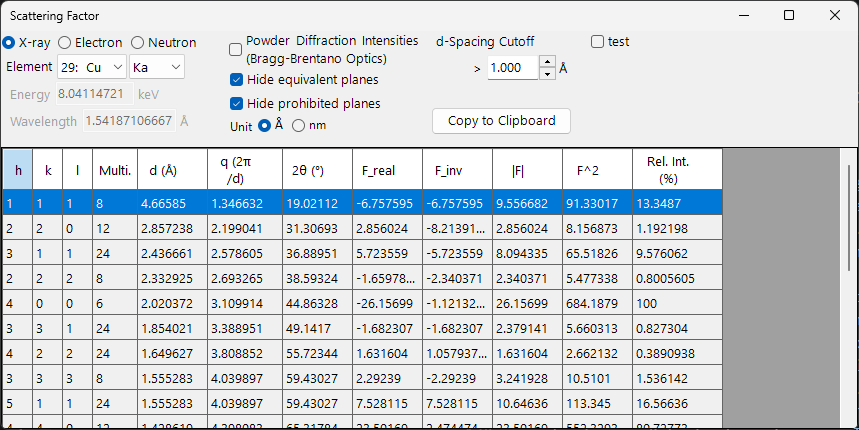
The calculation conditions are at the top of the window and the reflection list is at the bottom. The list is recomputed immediately whenever a condition changes.
Keyboard & mouse shortcuts
This window has no special key or mouse combinations. F1 opens this manual page, and Copy to clipboard exports the whole reflection table as spreadsheet-pasteable text.
Wave Length Control
- X-ray / Electron / Neutron : the atomic scattering factors differ by the type of incident beam, so they are switched here.
- For X-ray, choosing the Element (anode material) and characteristic line (Kα, etc.) sets the wavelength of that characteristic X-ray automatically.
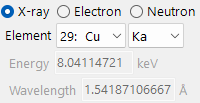
- Energy (keV) and Wavelength (Å) are linked to each other.
- This energy or wavelength is used to compute 2θ (the diffraction angle). For X-ray it can also be set via the element and line-type selection.
Display & calculation options
- Powder Diffraction Intensities (Bragg-Brentano Optics) : computes the relative intensity as a powder-diffraction (Bragg–Brentano) intensity, including multiplicity and the Lorentz–polarization factor. When off, it displays the structure-factor intensity.
- Hide equivalent planes : collapses crystallographically equivalent planes into a single entry.
- Hide prohibited planes : excludes planes whose intensity is zero by the extinction rules.
- Unit (Å / nm) : switches the length unit for d-spacing, etc.
- d-Spacing Cutoff : excludes reflections with a d-spacing smaller than this value.
Reflection list
Each row corresponds to one reflection (or a group of symmetry-equivalent planes).
| Column | Meaning |
|---|---|
| h, k, l | Miller indices |
| Multi. | multiplicity (number of symmetry-equivalent planes) |
| d (Å) | interplanar spacing |
| q (2π/d) | magnitude of the scattering vector |
| 2θ (°) | diffraction angle for the selected wavelength |
| F_real | real part of the structure factor |
| F_inv | imaginary part of the structure factor |
| |F| | structure-factor amplitude (\(= \sqrt{F_\text{real}^2 + F_\text{inv}^2}\)) |
| F^2 | structure-factor intensity (\(\lvert F\rvert^2\)) |
| Rel. Int. (%) | relative intensity, with the strongest reflection set to 100 |
Copy to Clipboard
Copy to Clipboard copies the list to the clipboard as text that can be pasted into a spreadsheet such as Excel.
See also
- Appendix top
- 4. Practical procedures — defining the standard crystal whose structure factors are calculated.
- 6. Find Parameter (brute force)