1. Ruby fluorescence
Pressure is determined from the shift of the ruby R1 fluorescence line, the most widely used pressure gauge in diamond-anvil-cell experiments. Select Ruby Fluorescence at the top of the main window.
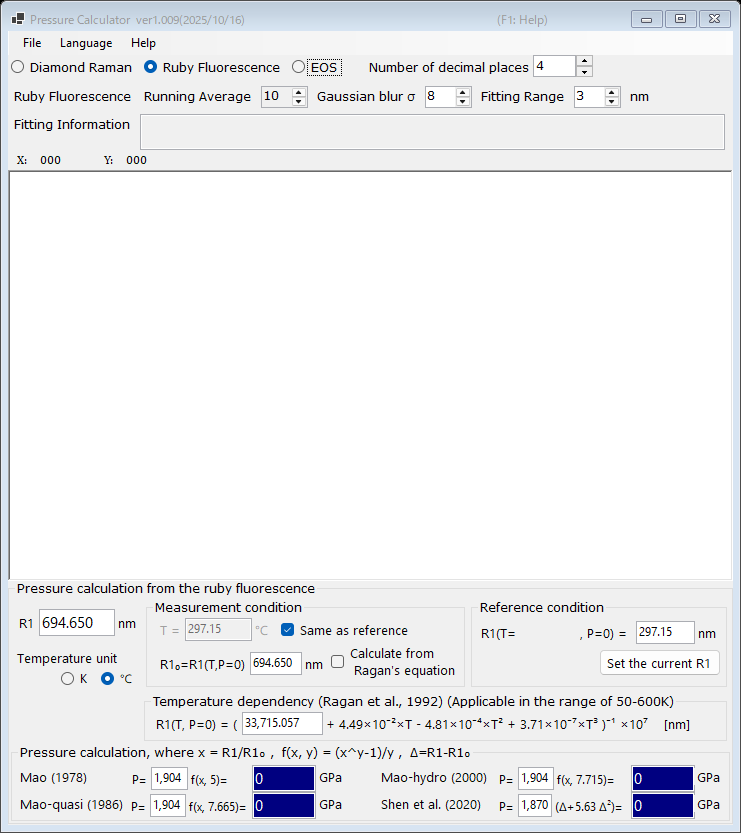
Workflow
- Load a fluorescence spectrum (see Spectra and fitting), or type the R1 wavelength directly into the R1 box (in nm).
- When a spectrum is loaded, PressureCalculator fits the R1 and R2 lines within the Fitting Range (pseudo-Voigt profiles with a linear background) and displays the fitted peak positions and widths in the Fitting Information box.
- Set the reference condition (the R1 wavelength R1₀ at zero pressure) in the Reference condition group. Set the current R1 copies the currently fitted R1 into the reference box.
- The pressure calculated with each ruby scale is displayed in the Pressure calculation group (in GPa).
Ruby scales
The pressure is calculated as
\[P = \frac{A}{y}\left[\left(\frac{R1}{R1_0}\right)^{y} - 1\right]\]
with the following parameter sets (the coefficients are editable):
| Scale | Note |
|---|---|
| Mao (1978) | A = 1904 GPa, y = 5 |
| Mao-quasi (1986) | quasi-hydrostatic conditions, y = 7.665 |
| Mao-hydro (2000) | hydrostatic conditions, y = 7.715 |
| Shen et al. (2020) | international practical ruby scale, P = 1870 × Δ(1 + 5.63 Δ), Δ = (R1 − R1₀)/R1₀ |
Temperature correction
The R1 line also shifts with temperature. The Temperature dependency (Ragan et al., 1992) group corrects for this effect, using the measured temperature and the reference temperature; it is applicable in the range of 50-600 K.
- Temperature unit : Kelvin or Celsius.
- Same as reference : assume the measurement temperature equals the reference temperature.
- Calculate from Ragan's equation : compute R1₀ at the given temperature from Ragan's equation instead of typing it manually.