螢幕截圖為英文
IPAnalyzer 的介面目前僅在地化為英文與日文,因此本頁的螢幕截圖以英文顯示,即使內文已翻譯。
Appendix A2. Parameter determination
由於每個像素的位置都由 A1. Detector geometry 的幾何所決定,使用錯誤的參數就意味著在錯誤的位置讀取強度。本頁說明如何從標準物質的繞射環,決定真實的參數——相機長度、波長、像素尺寸與 IP 傾斜。實際操作請參閱 4. Practical procedures 與 6. Parameter calibration (brute force)。
Standard material
進行校正時,您要量測一個晶格常數為已知的標準物質。理想的條件是具有眾多繞射環、高 SN 比、分布稀疏,且無擇優取向。若無特別偏好,建議使用含有重原子的立方晶,例如 \(\mathrm{CeO_2}\) 或 \(\mathrm{Ag}\)。晶格常數必須已知到約 5 位有效數字。
Camera length — two-distance method
相機長度 \(\mathrm{CL}\) 定義為連接試樣與 IP 上直射斑點的距離。若在改變相機長度 \(\Delta\) 的同時拍攝兩張繞射圖樣,便可從同一個環的半徑(以像素為單位)\(r_1,\ r_2\) 的變化量,決定 \(\mathrm{CL}\) 的絕對值。距離差 \(\Delta\) 可以用 Magnescale 之類的裝置精確地控制。
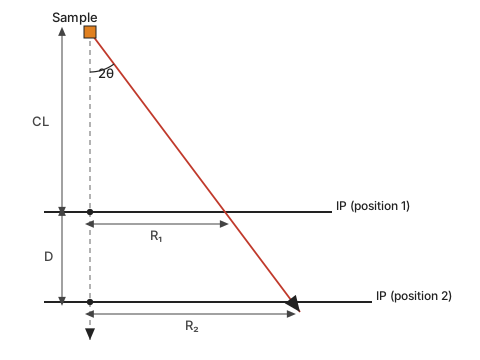
由相似三角形 \(\dfrac{r_1}{\mathrm{CL}} = \dfrac{r_2}{\mathrm{CL}+\Delta} = \tan 2\theta\),
即可求得。此處 \(r_1,\ r_2\) 可維持像素單位,並且即使傾斜校正與像素尺寸校正稍有不準確,乃至標準物質的晶格常數不準確,仍能求得相機長度。由於相機長度因此與其他參數的相關性甚低,它是應最先決定的參數。
Wavelength and pixel size — two-line method
若能記錄到兩條繞射線,則無須知道像素尺寸或相機長度,即可從其峰值位置(以像素為單位)的比值 \(p_1,\ p_2\) 與其 d-spacing \(d_1,\ d_2\),計算出繞射角 \(\theta_1,\ \theta_2\)。設 d-spacing 比為 \(\rho_d = d_1/d_2\),峰值位置比為 \(\rho_p = p_1/p_2\)。
由 Bragg 定律與平板偵測器的幾何,
成立。由第一式的比值得 \(\sin\theta_2 = \rho_d \sin\theta_1\),由第二式的比值得 \(\rho_p = \tan 2\theta_1 / \tan 2\theta_2\)。代入 \(\tan 2\theta = \dfrac{2\sin\theta\sqrt{1-\sin^2\theta}}{1-2\sin^2\theta}\),得到唯一未知數為 \(\sin\theta_1\) 的方程式:
這可化為關於 \(\sin^2\theta_1\) 的三次方程式。由於解析求解需要處理虛數,本軟體以數值方式求解以取得其值。由於 \(\rho_d\) 是 d-spacing 的比值,依晶體對稱性(例如立方晶系)可以無誤差地決定。
一旦求得繞射角,相機長度便可由上述兩距離法獨立決定,因此波長 \(\lambda\) 與像素尺寸 \(\mathrm{PixSize}\) 也能輕易地由上述兩式計算出來。
When there is a tilt
若 IP 有傾斜,則關係式 \(p_i \cdot \mathrm{PixSize} = \mathrm{CL}\tan 2\theta_i\) 不再成立,因此無法直接求得準確的值。此情況下,請交替進行傾斜校正與波長校正,使解疊代地收斂至真實值。
IP tilt — ellipse fitting
錐角為 \(2\theta\) 的環,在未傾斜的 \(XY\) 平面上應觀察為半徑 \(R_0 = \mathrm{CL}\tan 2\theta\) 的正圓。然而在傾斜的 IP 上,該環會變成橢圓,而且其中心並不與束流中心(直射斑點)重合。
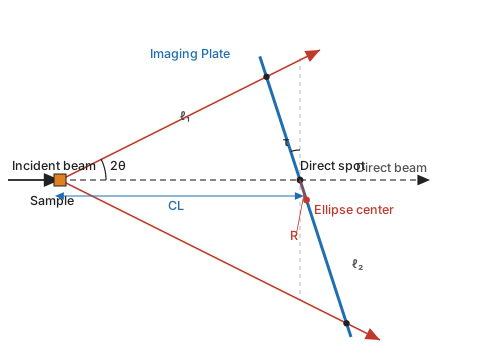
在以 \(\varphi,\ \tau\) 傾斜的 IP 平面上,環上的一點 \((x,y)\) 滿足一般的圓錐曲線(橢圓)
係數 \(A,B,C,D,E\) 可寫成 \(\varphi,\ \tau,\ \mathrm{CL},\ R_0\) 的函式,並可用如下的初等線性代數處理。
- 橢圓的中心 \((x_c, y_c)\) 是梯度為零此條件的解,亦即聯立線性方程式 $$ \begin{pmatrix} A & B \ B & C \end{pmatrix}\begin{pmatrix} x_c \ y_c \end{pmatrix} = -\frac{1}{2}\begin{pmatrix} D \ E \end{pmatrix} $$
- 長軸與短軸的方向及長度,可藉由求解對稱矩陣 \(\begin{pmatrix} A & B \\ B & C \end{pmatrix}\) 的特徵值問題而獲得。
由這些結果,傾斜可如下決定。
- 方位角 \(\varphi\):橢圓中心的位移沿著最陡傾斜方向(最大梯度方向)發生,而傾斜軸與其正交。因此傾斜軸的方向由 \((-y_c,\ x_c)\) 給出,並由此決定 \(\varphi\)。
-
傾斜量 \(\tau\):考慮沿 \(\varphi\) 方向投影的圖形(上圖),由直射斑點到橢圓中心的距離 \(R\) 滿足一個相機長度、傾斜量與繞射角的函式:
\[ R = \frac{\mathrm{CL}\,\sin 2\theta}{2}\left( \frac{1}{\cos(2\theta+\tau)} - \frac{1}{\cos(2\theta-\tau)} \right) \]對 \(\tau\) 求解此方程式。當有多個繞射環可用時,取從各環求得的 \(\tau\) 的加權平均作為真實值。