A4.2. Group–Subgroup Relations
Group Relations… is a browser for the maximal-subgroup / minimal-supergroup relations of the 230 space-group types, opened from the Options panel of Symmetry Information. Unlike a static table, every relation it shows is computed at run time directly from the current space group's own symmetry operations (see A4.1), so it can be cross-checked operation by operation rather than only trusted as a transcription of International Tables, Vol. A1.
This page explains the group-theory vocabulary the browser uses, and then walks through each of its tabs.
Hermann's theorem: t-, k-, and isomorphic subgroups
A subgroup \(H<G\) is maximal if no subgroup of \(G\) lies strictly between \(H\) and \(G\). A theorem due to Carl Hermann (1929) says that, for the 3-dimensional space groups tabulated here, every maximal subgroup of a space group \(G\) is one of two kinds:
- translationengleiche (t-) subgroup — "translations-equal": \(H\) keeps all of \(G\)'s translations (the same lattice, the same cell), but a smaller point group. The index \([G:H]\) (the number of cosets of \(H\) in \(G\)) equals the point-group index \([P_G:P_H]\).
- klassengleiche (k-) subgroup — "class-equal": \(H\) keeps the same geometric crystal class (point-group type) as \(G\), but only a sublattice of \(G\)'s translations — a larger conventional cell, and/or fewer centring vectors. The index equals the translation-lattice index \([T_G:T_H]\).
Isomorphic subgroups are the special, important case of k-subgroups where \(H\) is additionally of the same space-group type as \(G\) itself (only a larger cell — a relationship that repeats indefinitely, so isomorphic subgroups form an infinite series indexed by cell size, unlike the finitely many t- and non-isomorphic k-subgroups of a given \(G\)). For a maximal isomorphic subgroup the index is always a prime power (\(p\), and in three dimensions occasionally \(p^2\) or \(p^3\)); which power occurs depends on how the finite quotient lattice decomposes as a module under the point group. Note also that a sublattice's basis change can carry a genuine change of basis vectors and an origin shift, not merely a uniform enlargement of the cell along one axis.
Because every finite-index subgroup relation (maximal or not) can be reached as a chain of maximal steps, listing only the maximal subgroups (and, in the other direction, the minimal supergroups) is enough to describe the complete network of finite-index subgroup relations — which is exactly why ITA Vol. A1, and this browser, tabulate maximal/minimal relations only.
Only two kinds — isomorphic is a subclass, not a third
It is common shorthand to speak of "t-, k-, and isomorphic subgroups" as if there were three peers, and the tree in this browser is indeed organised into three branches for convenience. Formally, though, Hermann's theorem is a two-way split (t vs. k); isomorphic subgroups are simply the k-subgroups that happen to reproduce \(G\)'s own space-group type.
Index, as a coset count
Because space groups are infinite (they contain translations), "index" here always means the number of cosets of \(H\) in \(G\), not an order ratio \(|G|/|H|\) (both orders are infinite) — for finite groups the two notions coincide, but for space groups only the coset-counting definition makes sense. The tree and the Matrix tab both display this index as e.g. t, index 2 or k, index 3.
Conjugate subgroups and conjugacy class
A given abstract subgroup relation can often be realised inside \(G\) in more than one geometrically distinct way — related by orientation or location rather than by type — for instance a mirror plane's mirror image, or a screw axis along a differently-oriented but symmetry-equivalent direction. Two such realisations \(H\) and \(H'\) are conjugate within \(G\) if \(H' = gHg^{-1}\) for some \(g\in G\); the browser groups all such \(G\)-conjugate copies of one relation into a single entry and reports how many there are as the conjugacy class size. This is a strictly finer notion than grouping subgroups by the (coarser) equivalence under \(G\)'s Euclidean or affine normalizer — a classification ITA itself sometimes uses instead — so subgroups sharing the same type and index do not automatically belong to one conjugacy class; they can split into several.
Navigating the browser
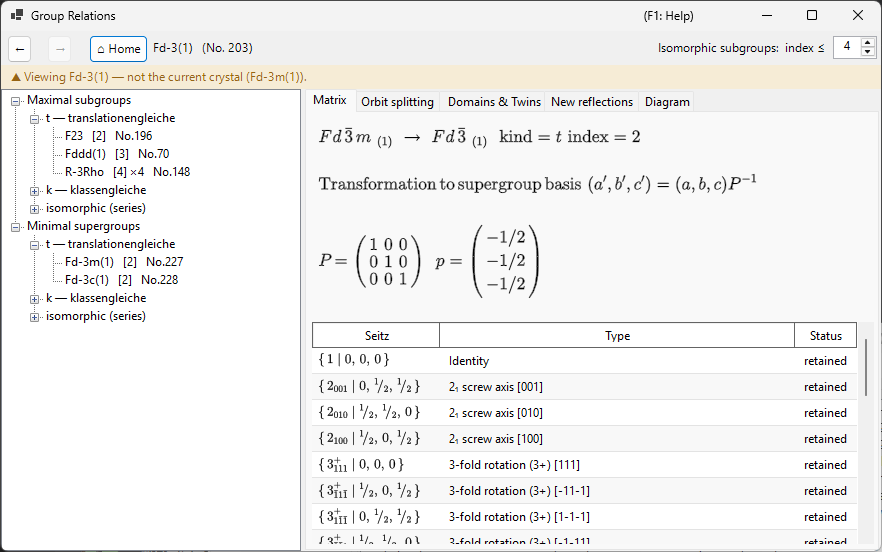
- Tree (left pane) has two roots, Maximal subgroups and Minimal supergroups, each split into a
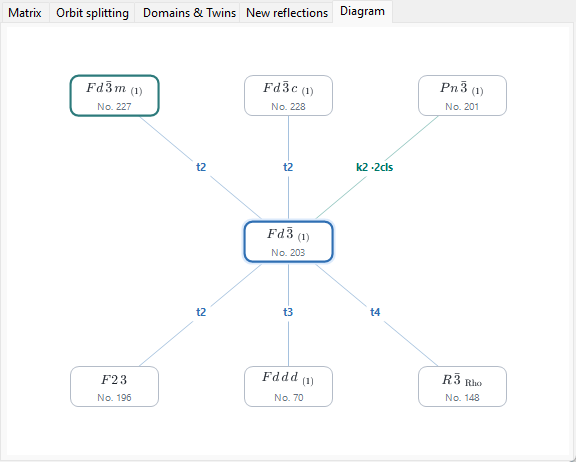
t — translationengleichebranch, ak — klassengleichebranch, and anisomorphic (series)branch. Non-conjugate classes that share the same child type and index would otherwise get identical labels, so they are distinguished by a· class nsuffix. In the isomorphic branch of Maximal subgroups, conjugacy classes that are equivalent under the affine normalizer of \(G\) are additionally grouped under one orbit row ("… — m classes (normalizer-equivalent)") — the same granularity as the IIc entries of ITA Vol. A1 — and the enumeration bound is set by the Isomorphic subgroups: index ≤ spinner on the toolbar (2–27, default 4; higher bounds are computed in the background). - Diagram tab draws a simplified Bärnighausen-style skeleton: the current group in the middle (highlighted), its minimal supergroups above and its maximal subgroups below — t-, k-, and isomorphic relations alike, since each is one "maximal step". Every edge is labelled with its kind and index (
t2,k3,i3), colour-coded blue for t, teal for k, and orange for isomorphic. Node symbols are typeset as proper crystallographic symbols — subscripts for screw axes, overbars for rotoinversions. Non-conjugate classes that share the same target type, kind, and index are merged into a single node whose edge label carries a class count (e.g.k2 ·2 cls) — the tree remains the place to inspect each class individually. When a row holds more relations than fit the window width, the nodes shrink one step and any remainder is collected into a dashed+Nnode (not clickable — use the tree for the full list); a smalli: index ≤ 4 onlyreminder appears in the corner whenever isomorphic edges are shown, andk: computing…while the k-supergroup lookup is still being built. When you double-click your way down through subgroups, the chain of groups you passed through (your selected branch) is drawn as a purple vertical column above the current group — a multi-level Bärnighausen tree of your own transition path (e.g. \(Pm\bar3m \rightarrow P4/mmm \rightarrow Pmmm \rightarrow \ldots\)), each edge labelled with the relation you took; ascending or pressing Back trims the branch accordingly, and chains longer than three ancestors are abbreviated with a dimmed⋮ +N. This shows the group-theoretic skeleton only — a full Bärnighausen tree in the structural-relationship sense also carries cell transformations, Wyckoff-splitting, and atom-coordinate correlations at each edge, which live in the other tabs described below rather than on the diagram itself. - Single-click (a tree node, or a Diagram node) selects a relation and populates the detail tabs below. Double-click navigates: it re-roots the whole browser at that space group, so you can walk step by step from group to subgroup to subgroup.
- Back / Forward / Home step through your navigation history; Home always returns to the space group of the crystal you actually opened the browser from.
- The breadcrumb (top) shows the space group currently displayed (
HM symbol (No. n)); the context banner below it turns green ("Viewing the current crystal's space group.") when that matches your crystal, or amber ("Viewing … — not the current crystal (…).") when you have navigated elsewhere — a reminder that browsing a subgroup does not change your crystal.
Matrix tab
Shows the basis change and origin shift between the parent setting and the child setting, using ITA's convention: the new basis vectors are \((\mathbf a',\mathbf b',\mathbf c')=(\mathbf a,\mathbf b,\mathbf c)\cdot P\), and a point's parent-setting coordinates are \(\mathbf x_{\text{parent}} = P\,\mathbf x_{\text{child}} + \mathbf p\). The \(3\times3\) matrix \(P\) and the origin shift \(\mathbf p\) are printed as fractions.
- When you reached this relation from Maximal subgroups, \(P\) and \(\mathbf p\) are shown directly (parent → child direction).
- When you reached it from Minimal supergroups instead, the tab shows \(P^{-1}\) (and the correspondingly inverted shift), captioned as "derived from the supergroup's own subgroup table" — the browser always stores a relation from the larger group's point of view and inverts it on demand, rather than maintaining two independent copies.
- Conjugate subgroups in this class: \(n\) reports the size of the conjugacy class described above.
- A generators table lists every coset representative, tagged retained (still present in \(H\)) or lost (present in \(G\) but not in \(H\) — these are exactly the operations responsible for the symmetry breaking), each with its Seitz symbol and geometric-type description from A4.1.
- If a candidate relation's target space-group type could not be identified against ReciPro's catalogue, the tab says so plainly instead of guessing, and shows only the point-group symbol.
Orbit splitting tab
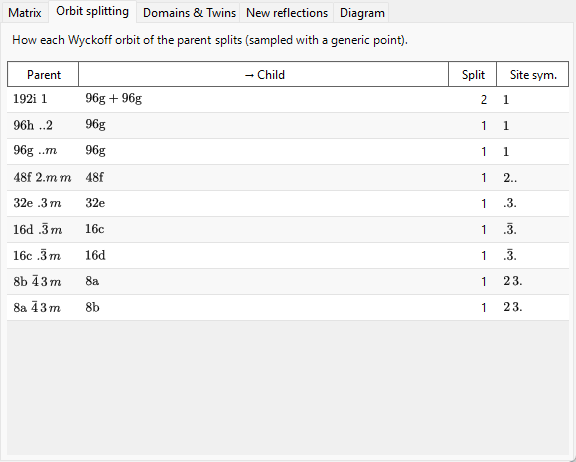
Shows how each of the parent group's Wyckoff positions splits when the symmetry is lowered to \(H\): one row per parent position, listing the parent's multiplicity/letter/site-symmetry, the resulting child multiplicities/letters (joined with + if the orbit splits into more than one), how many pieces it split into, and the distinct child site symmetries.
This is computed by actually substituting one fixed, generic sample point into both groups' operations and comparing the resulting orbits — a numerically sampled splitting, not the fully symbolic Wyckoff-splitting formalism (as used by tools such as WYCKSPLIT); it is deliberately labelled "Orbit splitting", not "Wyckoff splitting", for this reason — a fully symbolic treatment could in principle track every special-parameter coincidence, while this sampled approach reports only the splitting seen at one generic point and would not by itself flag a coincidence that occurs only for special values of \(x,y,z\).
For a k- or isomorphic relation the same sampled approach is applied to the coarser translation lattice: the tab shows how each parent orbit splits as lattice translations are lost, and the child multiplicities are counted in the enlarged subgroup cell (so for an index-\(n\) cell enlargement the multiplicities of the pieces sum to \(n\) times the parent multiplicity).
Domains & Twins tab
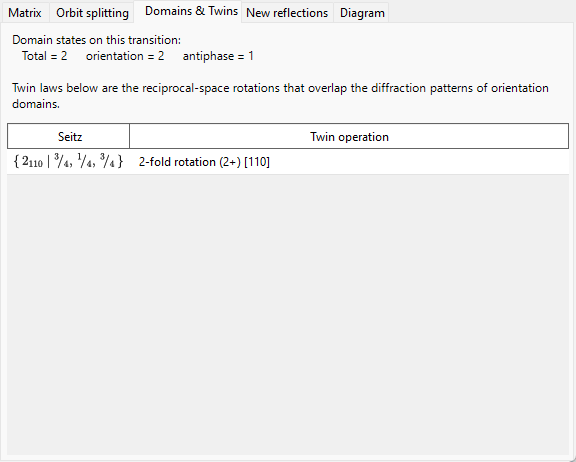
When a crystal transforms from \(G\) to a subgroup \(H\), each of the \([G:H]\) cosets of \(H\) in \(G\) corresponds to one possible domain state: the reference state is the identity coset, and each other coset — represented by one "lost" operation from the Matrix tab — generates one more domain state related to the reference by that operation.
For a t-subgroup specifically, the translation lattice is unchanged (\(T_G=T_H\)), so there is, group-theoretically, no such thing as an antiphase (translation) domain here — every domain state differs from the reference by a genuine point-group operation, never by a bare shift. The tab therefore always reports antiphase = 1 and orientation = total, i.e. all \([G:H]\) domain states are orientation domains.
For a k- or isomorphic transition the situation is exactly reversed: the point group is unchanged, so there is only one orientation state, and the lost lattice translations generate antiphase (translation) domains — the tab reports orientation = 1 and antiphase = total. Each lost translation is listed as a pure-translation Seitz symbol together with the corresponding antiphase vector expressed in the subgroup cell. Because all antiphase domains share the same orientation, their fundamental reflections coincide exactly; only the superlattice reflections (see the New reflections tab) carry a phase difference across an antiphase boundary.
The twin law for a pair of orientation domains is the lost operation's matrix part — a rotation or reflection, expressed as acting on the direct or reciprocal lattice — that maps one domain's lattice orientation onto the other's. For a t-subgroup transition, this operation is by construction a symmetry of the parent group \(G\)'s lattice, so if the low-symmetry structure's actual metric still has that lattice symmetry, the two domains' reciprocal lattices coincide exactly after the twin operation and their diffraction patterns overlap completely — the idealised case of merohedral twinning that this tab describes. In a real transition the low-symmetry phase typically develops a small spontaneous strain that only approximately keeps the parent's metric, so in practice the overlap is often only approximate (pseudo-merohedral twinning); this tab reports the group-theoretical, exact-metric twin law, not a measurement of how closely a particular real crystal approaches it.
A degenerate case with an empty coset list is reported as (single domain) (index 1 is never shown as a relation).
New reflections tab
For a t-subgroup transition, lists the reflections that become symmetry-allowed in \(H\) although they were systematically absent in \(G\) — i.e. reflections for which the parent's reflection conditions (from the Conditions tab) forbid them, but \(H\)'s do not. The search window is set by the Search window spinner on the tab: \(|h|,|k|,|l|\le4\) by default, adjustable from 2 to 8 (larger bounds can list many more reflections).
Because a t-subgroup never enlarges the unit cell, these are not superstructure/fractional-index reflections — they remain integer \((h,k,l)\) of the parent cell, and only become allowed because a glide plane or screw axis that used to force them to vanish is no longer present. (Genuine superstructure reflections at fractional parent indices are only possible once the cell itself enlarges, which happens for a k-subgroup, not a t-subgroup.) A reflection appearing here is only symmetry-permitted; whether it is actually observed still depends on the structure factor of the real, lower-symmetry structure.
For a k- or isomorphic relation the tab lists the new reflections indexed on the enlarged subgroup cell (again within the search window) and classifies each one in the last column:
- superlattice reflections map to fractional parent indices, shown in parentheses (e.g.
(1/2 0 1)) — they appear purely because the cell enlarged; - released reflections are integer in the parent cell but were forbidden by a parent reflection condition that the subgroup lifts — the lifted parent rule is shown instead (this includes the loss of centring translations, e.g. an \(I\)-centred parent losing its \(h+k+l\) even condition).
Reflections allowed in both parent and child (fundamental reflections) are not listed. If the child's space-group type could not be identified, the child's reflection conditions are unknown and the tab says the prediction is not possible.
Point groups tab
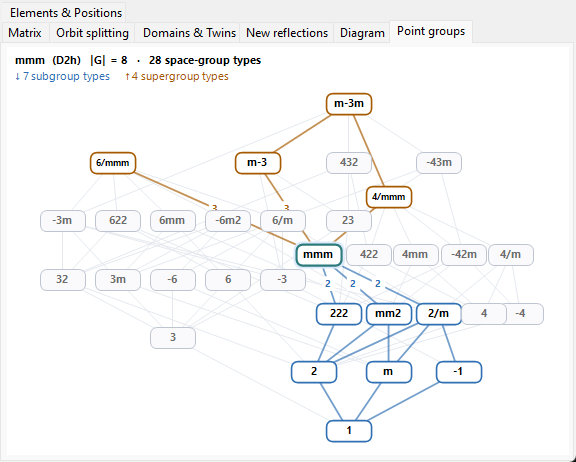
While the rest of the browser walks between space groups, this tab shows the wider map those walks live on: the Hasse diagram of the 32 crystallographic point-group types (geometric crystal classes) — the partial order of which type occurs as a subgroup of which. Each node is one point-group type; the vertical axis is the group order (1 at the bottom, 48 at the top, on a logarithmic scale), with the hexagonal/trigonal family forming the left tower and the cubic–tetragonal–orthorhombic tower on the right. An edge is a maximal (covering) subgroup relation — no third type fits strictly in between — and there are exactly 80 such edges among the 32 types. The diagram is a partial order but not a lattice in the mathematical sense: it has two maximal elements, \(m\bar3m\) and \(6/mmm\), which are not comparable.
- The point group of the space group you are browsing carries a pale-blue halo (like the current node of the Diagram tab) and is the focused type by default.
- Click any node to focus it instead: its subgroup types highlight blue, its supergroup types orange, and the numbers on the focused node's own edges are the index (order ratio) of that maximal step. Types unrelated to the focus stay grey. Clicking empty space returns the focus to the current point group. (Clicking never navigates anywhere — a point-group type corresponds to many space groups, not to one.)
- The caption at the top summarises the focused type: Hermann–Mauguin and Schoenflies symbols, the group order \(|G|\), how many of the 230 space-group types belong to it, and the sizes of its subgroup/supergroup sets.
This diagram is the point-group shadow of Hermann's theorem: one t-subgroup step in the tree moves down exactly one edge here (the space-group index of a t-step equals the point-group index on the edge), while k- and isomorphic steps stay on the same node.
Elements & Positions tab
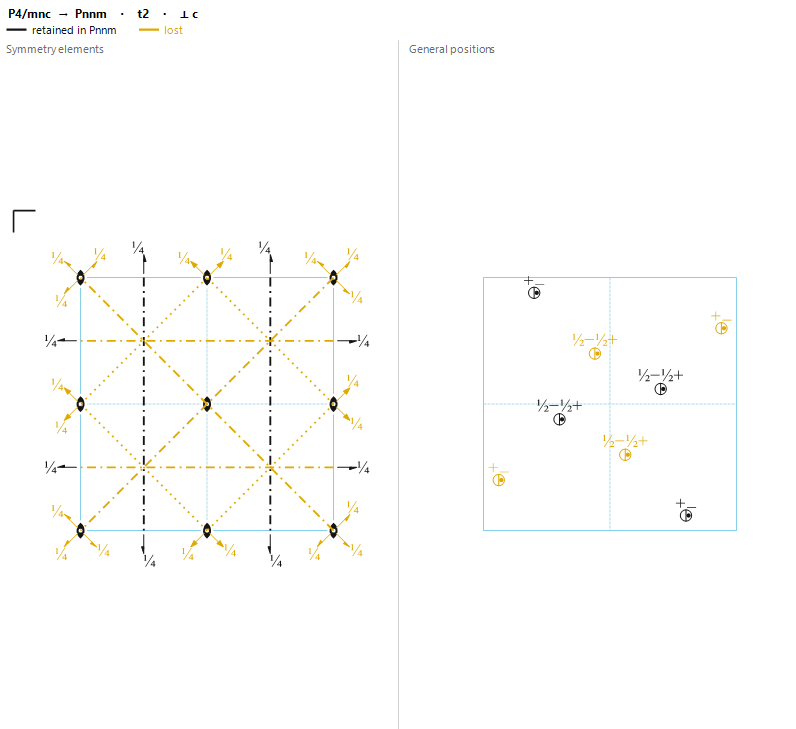
Where the Matrix tab lists the retained and lost operations as a table, this tab shows the same information geometrically, in the two figures crystallographers already read side by side in ITA Vol. A: on the left, the parent's symmetry-element diagram (axes, planes and inversion centres); on the right, the parent's general-position diagram. Both follow one colour rule — what survives in \(H\) is black, what is lost is yellow, with the unit cell drawn in blue underneath — so the tab answers at a glance: which symmetry elements break, and how the general-position orbit splits, when the crystal transforms from \(G\) to the subgroup \(H\). The projection direction (⟂ a, b or c) is chosen automatically for the parent's crystal system, and the header names the relation, its kind and index, and the projection.
Left — symmetry elements.
- The overlay draws the symmetry elements reconstructed directly from \(H\)'s own operation set in black, over the parent's elements that are lost in yellow — so retained elements are precisely those that reappear in \(H\), with no symbol-by-symbol guessing.
- A symmetry element degrading to a lower one is shown by the surviving symbol alone: where a 4-fold axis keeps only its 2-fold, just the black 2-fold symbol appears. A lost element is printed in yellow only where nothing survives at its geometric locus, so the surviving symmetry stays legible.
The left figure handles three situations, according to how the subgroup's cell relates to the parent's:
- Same conventional cell — translationengleiche (t-) subgroups, and klassengleiche (k-) subgroups that only remove centring vectors (\(\det\) of the sublattice basis \(= 1\)). Here \(H\)'s elements live in the parent's cell, so the overlay is a single parent-cell diagram. (A centring-removing k- relation, e.g. \(I\)- or \(F\)-centred \(\to\) primitive, shows the centring-generated screw axes and glide planes turning yellow.)
- In-plane cell enlargement — k- or isomorphic relations whose enlargement lies in the a–b plane (\(a'=n_a a\), \(b'=n_b b\), with c unchanged) in an orthorhombic, tetragonal or cubic parent. The enlarged cell is drawn (projected ⟂ c) as an \(n_a\times n_b\) grid of parent-cell tiles, and each tile is coloured independently: a symmetry element retained in \(H\) appears black in the tiles where that copy survives and yellow where the cell enlargement has removed it — so cell doubling shows up directly as every-other copy turning yellow.
- Otherwise (enlargement along the viewing axis \(c\), oblique/non-orthogonal cell changes, hexagonal/trigonal/monoclinic parents) the lost symmetry cannot be drawn unambiguously in a 2-D projection, so the tab shows a short note pointing to the Domains & Twins and New reflections tabs, which already carry the lost-lattice-symmetry information for those cases.
Right — general positions. Under \(G\) all drawn points form a single orbit (one general position); under \(H\) that orbit splits into \([G:H]\) sub-orbits (compare the Orbit splitting tab). The sub-orbit containing the representative point — the set that remains one general position of \(H\) — is drawn black; the points of the other sub-orbits, no longer equivalent to it once the symmetry is lowered, are yellow. Where the projection makes two equivalent points coincide, the standard ITA split circle is used: a circle divided by a vertical line, with a comma marking the mirror-image half and a height label (+, ½−, …) beside each half. If one half survives in \(H\) and the other is lost, the dividing line and the lost half's comma and height label are drawn in yellow, so a half-lost position can be read directly off the figure. The orbit colouring is shown for same-cell relations (t-, and centring-removing k-); for cell-enlarging relations the right panel shows a short note instead.
For R space groups displayed in the rhombohedral-axes (Rho) setting, neither figure can be drawn in this projection; the tab shows a note instead, and both diagrams are available in the hexagonal-axes (Hex) setting of the same R space group.
Current limitations
The browser's t- and k-subgroup engines, the t- and k-supergroup reverse lookups, and the isomorphic (IIc) classification are fully implemented and independently verified against the space-group operation tables, and the Orbit splitting, Domains & Twins, and New reflections tabs are live for every relation kind. The remaining limitations are shown as such rather than silently omitted:
- Isomorphic subgroups are enumerated up to the spinner bound (default index ≤ 4, at most 27). An isomorphic series continues indefinitely to higher indices, so the greyed-out note on the branch always states the current bound rather than pretending the list is complete. The normalizer-orbit grouping relies on a bounded search for normalizer generators; it is verified against ITA A1 for the tested cases, but a formal completeness proof for every group is future work — at worst an orbit could be displayed split into several rows, never wrongly merged.
- k-supergroups are computed in the background on first use (the reverse lookup needs the k-subgroup tables of every type in the same crystal class); the tree briefly shows a greyed-out "computing…" node (and the Diagram a "k: computing…" corner note) until it is ready.
Glossary
| Term | Meaning |
|---|---|
| Maximal subgroup / minimal supergroup | A subgroup (supergroup) with no other subgroup relation strictly between it and \(G\) |
| Index \([G:H]\) | The number of cosets of \(H\) in \(G\) |
| translationengleiche (t-) | Same translation lattice, smaller point group; index = point-group index |
| klassengleiche (k-) | Same point-group type, sublattice of translations (larger cell); index = lattice index |
| Isomorphic subgroup | A k-subgroup that is additionally of the same space-group type as \(G\) |
| Conjugacy class (within \(G\)) | The set of \(G\)-conjugate (\(gHg^{-1}\)) realisations of one subgroup relation |
| Orientation domain | A domain state related to the reference by a point-group operation |
| Antiphase (translation) domain | A domain state related to the reference by a lost translation only (possible for k-, not t-, transitions) |
| Twin law | The matrix part of a lost operation, mapping one orientation domain's lattice onto another's |
See also
- 2. Symmetry information — the GUI guide this appendix explains.
- A4.1. Space-group symbols and symmetry diagrams — the Seitz-symbol/geometric-type vocabulary used throughout the Matrix and Domains & Twins tabs.
- Appendix A4. Symmetry and Space Groups