Attenuation & Transport
Scattering factors describe a single scattering event; this page is about what happens to the beam as a whole as it travels through the solid — how fast it is removed, how deeply it penetrates, and (for electrons) how it slows down. The relevant physics is entirely different for the three beams, which is why the Attenuations & Transport tab changes its plots and tables so drastically with the radiation.
X-rays — absorption and refraction
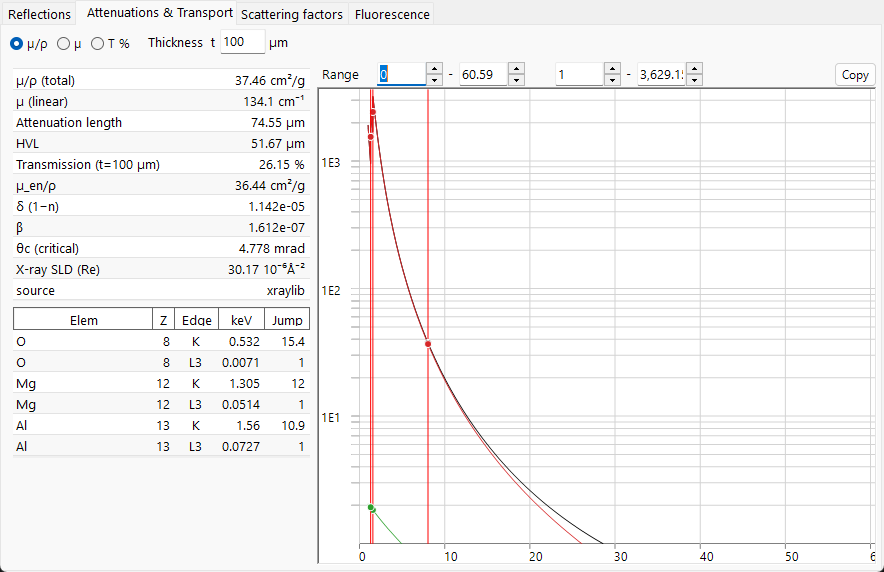
Beer–Lambert attenuation
A monochromatic X-ray beam is removed exponentially with path length:
- \(\mu/\rho\) : the mass attenuation coefficient (cm²/g) — the tabulated, density-independent quantity.
- \(\mu\) : the linear attenuation coefficient (cm⁻¹) at the material's actual density \(\rho\).
- \(1/\mu\) : the attenuation length (intensity falls to \(1/e\)).
- \(\text{HVL} = \ln 2/\mu\) : the half-value layer.
- \(T = e^{-\mu t}\) : the transmission for a sample of thickness \(t\).
What makes up \(\mu/\rho\)
The total mass attenuation is the sum of three processes, plotted separately in the tab:
For a compound the mass attenuation is the mass-weighted sum of the elemental values, while the linear coefficient adds up the atomic cross sections directly:
with \(w_i\) the mass fractions and \(n_i\) the number densities. The three components are:
- Photoabsorption \(\tau\) — a photon is absorbed and ejects a bound electron. It dominates at low energy, falling roughly as \(\tau/\rho \propto Z^{3\!-\!4}/E^{3}\) between edges. This is the term that ejects the inner-shell electron whose relaxation produces fluorescence.
- Rayleigh (coherent) scattering — elastic scattering off bound electrons, related to the coherent form factor \(F(q)\).
- Compton (incoherent) scattering — inelastic scattering off weakly bound electrons, related to the incoherent function \(S(q)\); it grows in relative importance at high energy. The scattered photon is shifted in wavelength by
so a Compton event removes the photon from the monochromatic beam (an inelastic loss).
The absorption edges are the sharp rises in \(\tau\) when the photon energy crosses the binding energy of a shell (\(K\), \(L_3\), …), opening a new ionisation channel. The jump ratio is the factor by which \(\mu/\rho\) increases across the edge; ReciPro lists the \(K\) and \(L_3\) edge energies and jumps. The mass energy-absorption coefficient \(\mu_\text{en}/\rho\) is the part of \(\mu/\rho\) that deposits energy locally (excluding the energy carried away by scattered and fluorescent photons).
Refraction, critical angle, and SLD
The X-ray refractive index of a solid is slightly less than 1, written
where \(n_i\) is the number density of element \(i\) and \(r_e\) the classical electron radius. Here \(\mu_\text{abs}\) is the absorptive part of the attenuation (tied to \(f''\)); it need not equal the total \(\mu\) above, which also contains Rayleigh and Compton scattering. When \(\delta>0\) the refractive index is smaller than 1, so X-rays undergo total external reflection below a small grazing critical angle \(\alpha_c\):
This follows from the refraction geometry: for a glancing angle \(\alpha\) the vertical wavevector inside the solid is \(k_z^2 \simeq k^2(\alpha^2 - 2\delta)\), which reaches zero at \(\alpha = \alpha_c = \sqrt{2\delta}\); below that the wave cannot propagate into the material and is totally reflected. The expression assumes the lossless limit \(\beta \ll \delta\): with a finite \(\beta\) an evanescent wave still penetrates a few nanometres and the reflectivity stays slightly below 1. Just above an absorption edge \(\delta\) can even become negative, in which case there is no critical angle and ReciPro reports none. The real part of the scattering-length density, \(\text{SLD} = r_e\sum_i n_i (Z_i + f'_i)\), sets \(\delta\) and is the X-ray analogue of the neutron SLD used in reflectometry. ReciPro reports \(\delta\), \(\beta\), \(\alpha_c\) (listed as θc in the scalar table), and the X-ray SLD.
Electrons — scattering, slowing, and range
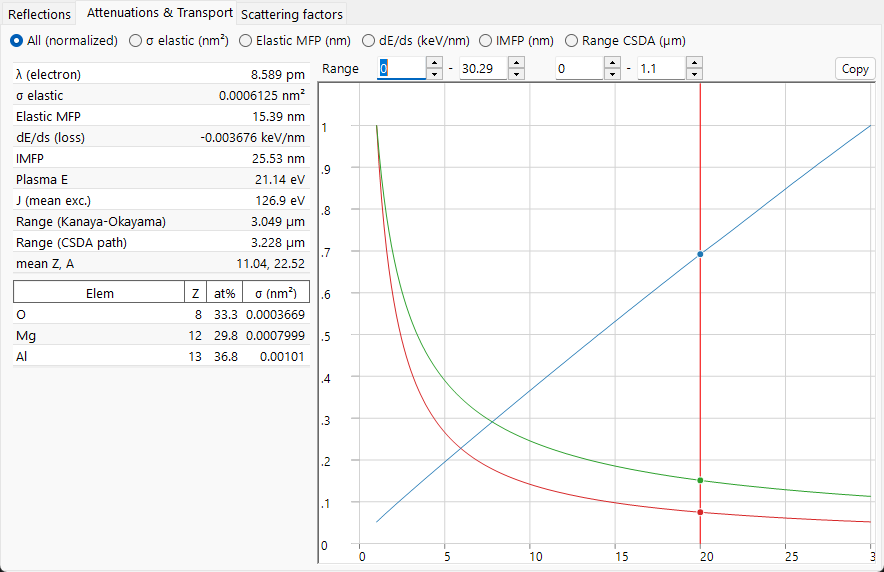
A fast electron in a solid both scatters (changing direction) and loses energy continuously, so its transport needs more than one length scale.
Elastic scattering and the mean free path
The elastic cross section \(\sigma_\text{el}\) measures how readily a single atom deflects the electron. ReciPro uses the NIST Mott cross sections (a partial-wave solution of the relativistic Dirac equation in the screened atomic potential). The bundled table covers 50 eV – 36.4 keV (that is the extent of ReciPro's own tabulation, not a limit of the Mott method itself); outside that range, or for elements not in the table, it falls back to the screened Rutherford approximation. The two need not join perfectly smoothly at the boundary. The total cross section is the angular integral of the differential one,
where the screening parameter \(\eta\) rounds off the forward divergence of the bare Rutherford cross section; the Mott treatment additionally includes the spin and relativistic effects that screened Rutherford omits. From the cross section,
give the macroscopic scattering coefficient and the elastic mean free path — the average distance between elastic events.
Stopping power and inelastic losses
Energy is lost mainly to electronic excitations (ionisation, plasmons). The stopping power is defined as a positive quantity,
where here \(s\) is the path length along the trajectory (the variable of the tab's |dE/ds| curve), not the scattering variable \(\sin\theta/\lambda\) used elsewhere in this appendix. The gradient \(dE/ds\) itself is negative, so the tab plots its magnitude \(S\) upward. At keV energies it follows, in concept, the Bethe form
with \(J\) the mean excitation energy of the solid. This non-relativistic sketch shows the scaling only; ReciPro evaluates the modified Jablonski (2008) form, which stays well-behaved at low energy (the older Joy–Luo (1989) empirical form is also implemented). The plasmon energy \(E_p\) in the scalar table is a related but separate characterisation of the same electronic excitations. The inelastic mean free path (IMFP) is the corresponding average distance between energy-losing collisions; ReciPro can evaluate it from the TPP-2M predictive formula,
with \(E\) in eV, \(\lambda_\text{in}\) in Å, and the parameters \(\beta_\text{T},\gamma_\text{T},C,D\) built from \(E_p\), the density, the band gap, and the valence-electron count.
Two kinds of range
- CSDA range — the continuous-slowing-down approximation integrates the stopping power to give the total path length travelled before the electron stops:
(In practice the integral runs down to a low-energy cutoff \(E_\text{cut}\), below which the Bethe sketch above no longer holds.)
- Kanaya–Okayama range — a widely used empirical estimate of the penetration depth (not the path length), accounting for the tortuous, scattered trajectory:
The two answer different questions — total distance flown vs. how far into the solid the electron reaches — so they differ in value, and ReciPro reports both. These ranges set the interaction volume behind electron trajectory and EBSD simulations.
Neutrons — macroscopic cross section and the 1/v law
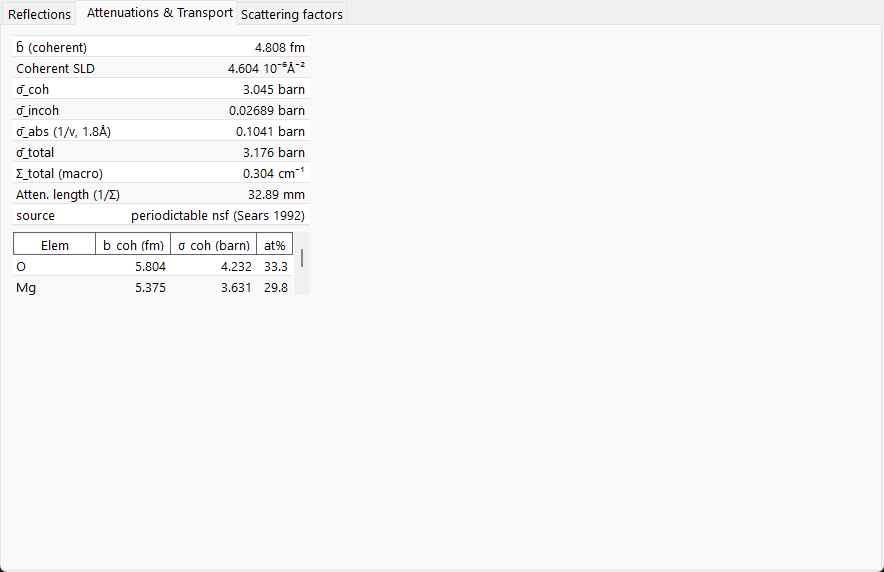
For neutrons there is no energy-dependent attenuation curve; the interaction is fixed by nuclear cross sections. The beam is attenuated through the macroscopic total cross section, itself the sum of coherent, incoherent, and absorption parts:
with attenuation length \(1/\Sigma_\text{total}\). The absorption part depends on the neutron speed \(v\) (hence wavelength): for most nuclides the time spent near the nucleus scales as \(1/v\), giving the 1/v law
A few strong absorbers (Cd, Sm, Eu, Gd) have low-energy resonances that violate the simple 1/v scaling; ReciPro flags these nuclides. The coherent scattering-length density, \(\text{SLD} = \sum_i n_i\, b_{\text{coh},i}\), is the neutron analogue of the X-ray SLD above.
Penetration at a glance
The three beams probe vastly different depths — the practical reason they answer different questions:
| Beam | Typical specimen | Penetration (order of magnitude) | Set by |
|---|---|---|---|
| X-ray (≈8 keV) | powder / single crystal | 10–100 µm | \(\mu = \rho(\mu/\rho)\) |
| Electron (≈200 keV) | TEM foil | 10–100 nm (useful) | elastic MFP + inelastic loss |
| Neutron (thermal) | bulk, cm-sized | 1–10 cm | \(\Sigma_\text{total}\) |
The same length scales explain why electrons demand ultrathin specimens and dynamical theory, while neutrons see an entire bulk sample under single-scattering kinematics.
See also
- Atomic scattering factors — the \(F(q)\)/\(S(q)\) split behind Rayleigh/Compton, and the Mott–Bethe relation (a different model from the NIST Mott cross sections used above).
- Fluorescence — the relaxation that follows X-ray photoabsorption.
- 3. Beam interaction — the Attenuations & Transport tab.
- 8. Electron trajectory · 12. EBSD simulation — where the electron ranges are used.