Structure Factor
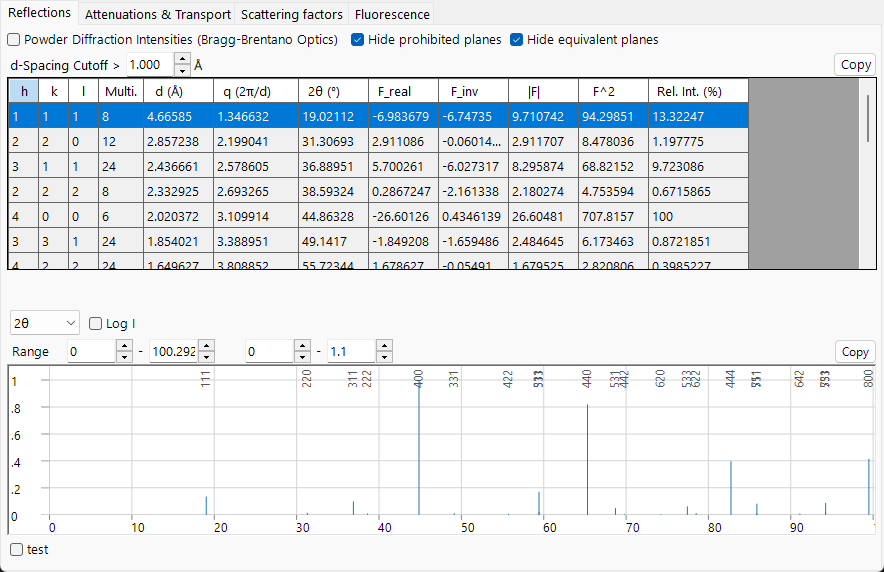
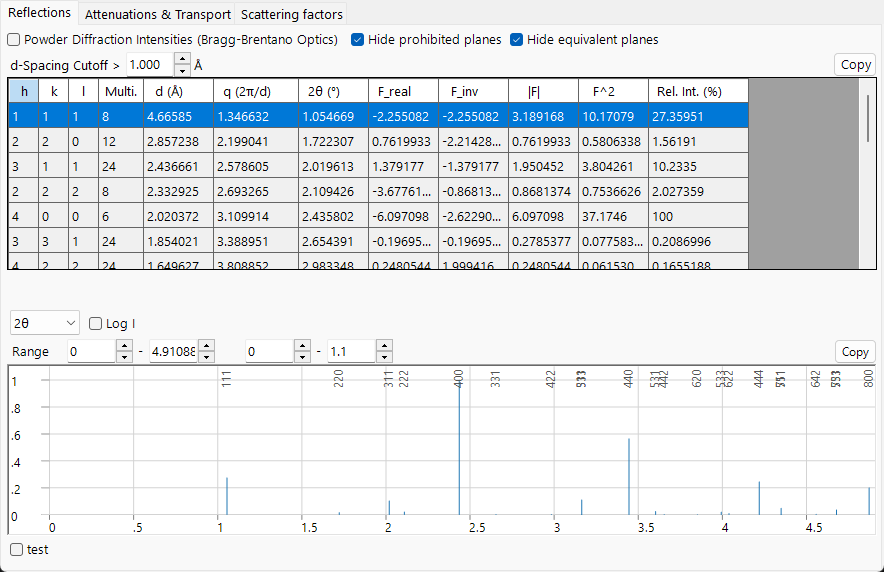
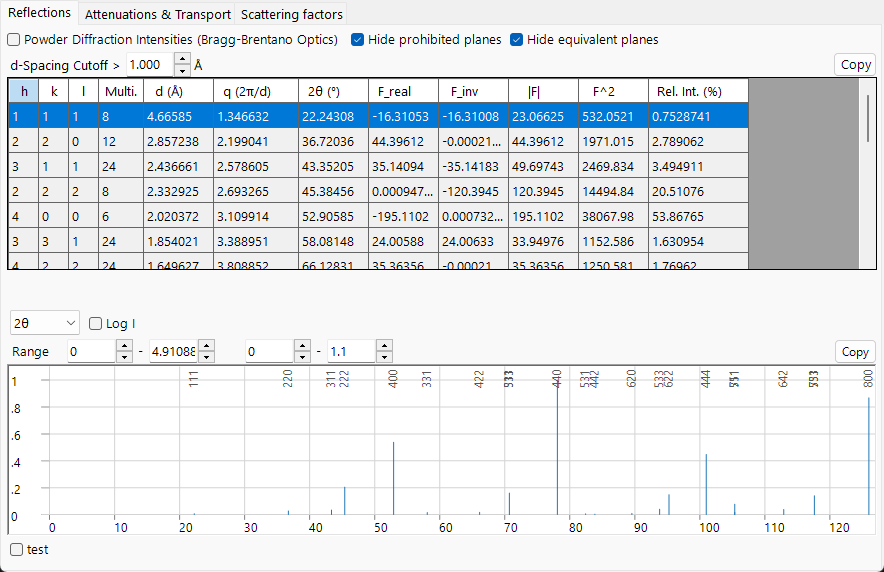
The atomic scattering factor describes one atom; the structure factor describes how all the atoms in the unit cell scatter together. It is the quantity the Reflections tab tabulates (F_real, F_inv, \(\lvert F\rvert\), \(F^2\)), and it is the bridge between the atomic physics of the previous page and the diffracted intensities.
Interference over the unit cell
The structure factor of reflection \(\mathbf g = (hkl)\) is the coherent sum of the atomic factors, each weighted by the phase from the atom's fractional position \(\mathbf r_j = (x_j,y_j,z_j)\):
- \(o_j\) : site occupancy (fractional, for partial or mixed occupation).
- \(f_j(s,E)\) : the atomic scattering factor of atom \(j\) for the current beam — \(f_0+f'-if''\) for X-rays in ReciPro's phase convention, \(f_e\) for electrons, \(b\) for neutrons.
- \(T_j(\mathbf g)\) : the Debye–Waller factor (below).
- The \(-2\pi i\) phase follows ReciPro's convention.
The intensity is the squared modulus,
which is the table's \(F^2\) column. F_real and F_inv are the real and imaginary parts of the complex structure factor. Even with purely real atomic factors, \(F_{\mathbf g}\) is generally complex for a non-centrosymmetric structure (or a shifted origin); X-ray anomalous dispersion (complex \(f\)) and complex neutron scattering lengths add a further imaginary contribution. F_inv vanishes for every reflection only when the structure is centrosymmetric with the origin at a centre of symmetry and all factors are real.
The Debye–Waller factor
Atoms vibrate about their equilibrium sites, smearing the scattering density and reducing the high-angle factors. For isotropic motion,
where \(\langle u_j^2\rangle\) is the mean-square displacement along the scattering direction and \(B_j\) is the isotropic displacement parameter (Ų). Anisotropic motion generalises this to
with \(\mathbf U_j\) the displacement tensor and \(\mathbf g\) the reciprocal-lattice vector (\(|\mathbf g|=1/d\), not \(Q=2\pi\lvert\mathbf g\rvert\)). For a Debye solid the mean-square displacement is itself a function of temperature \(T\), atomic mass \(M\), and Debye temperature \(\Theta_D\),
so \(B\) rises with temperature and falls for heavy atoms. ReciPro uses the tabulated or entered \(B_j\) directly rather than computing this. Because \(T_j\) multiplies the scattering factor, the Scattering factors tab can apply the same \(e^{-Bs^2}\) damping to the plotted curves. The damping grows with temperature and with \(s\), which is why thermal diffuse scattering (intensity removed from the coherent Bragg beams and redistributed into a diffuse background) feeds the absorptive potential in the dynamical theory (Appendix A3).
Extinctions: systematic vs accidental
A reflection can be absent for two distinct reasons:
- Systematic (space-group) absences. Lattice centering and symmetry elements with a translational component (screw axes, glide planes) make whole classes of reflections vanish exactly, for every crystal in that space group, regardless of the atomic contents. These are the rules behind Hide prohibited planes.
- Accidental near-extinctions. When the atomic contributions happen to cancel for a particular structure, the intensity is small but not symmetry-forbidden, and it can reappear if the composition or positions change. These are not removed by the extinction rules.
A systematic absence is a phase cancellation among the symmetry-related copies of the cell. For centering translations \(\mathbf t_\alpha\) the structure factor carries a common factor
which is zero for certain \(hkl\). For body-centring (\(\mathbf t = \tfrac12,\tfrac12,\tfrac12\)),
The most common systematic absences are:
| Symmetry element | Condition for absence | Reflections affected |
|---|---|---|
| \(I\) (body-centred) | \(h+k+l\) odd | all \(hkl\) |
| \(F\) (face-centred) | \(h,k,l\) mixed parity | all \(hkl\) |
| \(C\) (C-centred) | \(h+k\) odd | all \(hkl\) |
| \(2_1\) screw \(\parallel b\) | \(k\) odd | \(0k0\) |
| \(a\)-glide \(\perp b\) | \(h\) odd | \(h0l\) |
| \(c\)-glide \(\perp b\) | \(l\) odd | \(h0l\) |
Centering conditions apply to every reflection; screw and glide conditions apply only to the corresponding axial row or zone, which is exactly what makes them diagnostic of the space group.
Friedel's law and its breakdown
For a structure of real (non-resonant) scattering factors, conjugating the sum and flipping the sign of \(\mathbf g\) shows directly that (suppressing the real weights \(o_j T_j\) for clarity)
Diffraction then appears centrosymmetric even when the crystal is not. Anomalous dispersion can break this. Writing the structure factor as a normal part (which conjugates cleanly) plus an anomalous part, \(F_{\mathbf g} = A_{\mathbf g} - i B_{\mathbf g}\) and \(F_{-\mathbf g} = A_{\mathbf g}^{*} - i B_{\mathbf g}^{*}\) in ReciPro's \(f = f_0 + f' - i f''\) convention, the Bijvoet difference is
non-zero only when the normal and anomalous parts have different phases — that is, when chemically distinct anomalous scatterers occupy non-centrosymmetric sites. (The difference vanishes for a centrosymmetric structure, a single element, or any case where every atom carries the same complex factor.) This is what allows the absolute structure (handedness) of a non-centrosymmetric crystal to be determined, and it is the physical reason ReciPro reports a non-zero F_inv and distinct \(\lvert F\rvert\) for Friedel pairs once an X-ray energy near an edge is chosen.
From structure factor to powder intensity
Switching on Powder Diffraction Intensities (Bragg–Brentano) converts \(\lvert F\rvert^2\) into a relative powder intensity by folding in the geometry of a randomly oriented polycrystal:
- \(m_{hkl}\) : multiplicity — the number of symmetry-equivalent planes that overlap at the same \(2\theta\) (the table's Multi. column).
- \(Lp(\theta)\) : the Lorentz–polarisation factor for Bragg–Brentano optics, \(Lp = \dfrac{1+\cos^2 2\theta}{\sin^2\theta\,\cos\theta}\), which strongly boosts the low-angle peaks.
Because equivalent planes are merged into one line in this mode, ReciPro also forces Hide equivalent planes and Hide prohibited planes on.
See also
- Atomic scattering factors — the \(f_j\) that enter the sum.
- Attenuation & transport — what happens to the beam between scattering events.
- 3. Beam interaction → Reflections tab
- Appendix A3. Dynamical diffraction — when \(\lvert F\rvert^2\) (kinematical) is no longer enough.