Appendix A4. Symmetry and Space Groups
The main-window chapter 2. Symmetry information is a guide to the GUI: it tells you which tab shows what, and which button copies which diagram. This appendix collects the crystallographic and group-theoretical background behind those tables and pictures — what a Hermann–Mauguin symbol actually encodes, how to read the International Tables for Crystallography (ITA) Vol. A-style symmetry-element and general-position diagrams, and what the Group Relations… window's supergroup/subgroup tables and terminology (translationengleiche, klassengleiche, conjugacy class, domains, twin laws, …) mean.
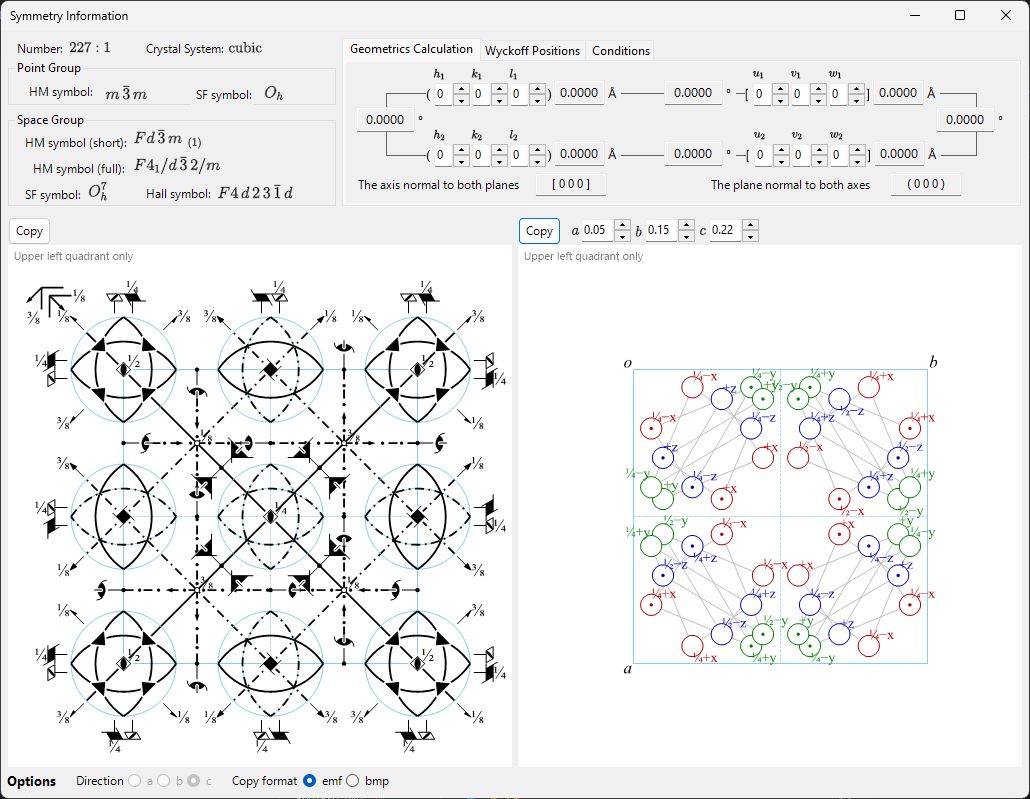
Two windows are covered, and the theory is best read in this order:
- A4.1. Space-group symbols and symmetry diagrams — the Hermann–Mauguin, Schoenflies, and Hall symbols; the group-theoretical classification shown on the Properties tab (centrosymmetric, Sohncke, symmorphic, polar, arithmetic crystal class, Patterson symmetry, …); the coordinate-triplet/Seitz/geometric-type description of each symmetry operation on the Operations tab; and the graphical conventions of the symmetry-element and general-position diagrams at the bottom of the Symmetry Information window.
- A4.2. Group–subgroup relations — what a maximal subgroup / minimal supergroup is, Hermann's t-/k- distinction, and how to read every tab of the Group Relations… browser (Diagram, Matrix, Orbit splitting, Domains & Twins, New reflections) opened from the Options panel of Symmetry Information.
A4.1 comes first because A4.2 constantly refers back to it: every subgroup/supergroup relation is itself labelled with the very same Hermann–Mauguin symbols, Seitz symbols, and geometric-type phrases ("3-fold rotation", "c-glide plane", "screw axis", …) introduced there.
Scope and sources
ReciPro's built-in database covers the 230 space-group types (with 530 tabulated settings/origin choices) exactly as tabulated in International Tables for Crystallography, Volume A (space-group symmetry) and Volume A1 (maximal subgroups of space groups). This appendix explains ReciPro's presentation of that data — the notation, the diagrams, the browsing tool — and assumes the reader already has an undergraduate-level acquaintance with lattices, point groups, and the idea of a symmetry operation. It is not a substitute for ITA itself, which remains the authoritative reference for the tabulated data (and which ReciPro cannot reproduce verbatim for copyright reasons — see the Settings tab for ReciPro's own listing of alternative origins/settings for a given space-group type).
Group Relations… is an actively developed feature
The Group Relations… browser (A4.2) computes translationengleiche (t-) and klassengleiche (k-, including isomorphic) subgroups and supergroups directly from the space group's own symmetry operations (not from a pre-tabulated list), so every relation shown is independently verified rather than copied from a table. The remaining limits — e.g. the isomorphic series is enumerated only up to index ≤ 4 — are spelled out in A4.2's Current limitations.
See also
- 2. Symmetry information — the GUI guide this appendix explains.
- A4.1. Space-group symbols and symmetry diagrams · A4.2. Group–subgroup relations
- Appendix A1. Coordinate systems
- Appendix A2. Beam interaction (solid-state background) — where the space-group's reflection conditions (systematic absences) feed into the structure factor.